
Introduction: Can a Crime Committed Abroad Be Tried in the Philippines?
Imagine a person acquires an item overseas, travels back to the Philippines, and completes an important act involving that item upon arrival. The person may argue that Philippine courts have no jurisdiction because the conduct began abroad.
However, the location of the first act does not always determine whether Philippine criminal law applies.
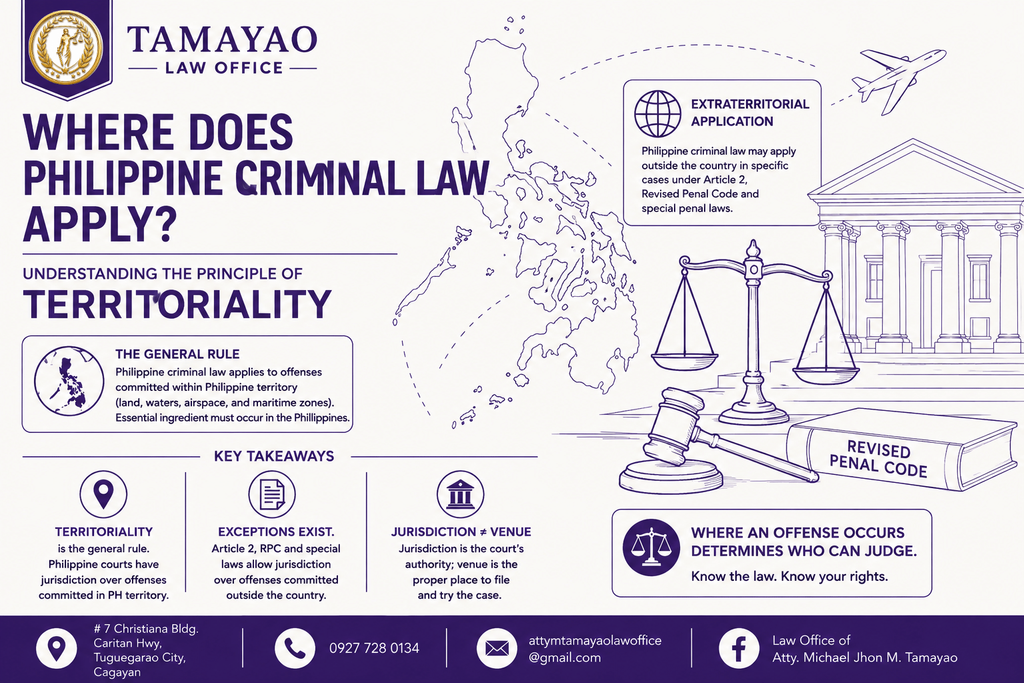
Under Philippine law, criminal jurisdiction generally follows the principle of territoriality. In simple terms, Philippine criminal laws ordinarily apply to offenses committed within Philippine territory. Yet, the law also recognizes situations where Philippine courts may exercise jurisdiction even when some acts occurred outside the country.
This distinction matters because the place where an offense occurs can determine whether Philippine courts have authority to hear a criminal case.
For more educational discussions on Philippine law, readers may also explore the Articles section of Tamayao Law Office.
The Legal Doctrine: Territoriality as the General Rule
The general rule states that Philippine criminal law applies to crimes committed within Philippine territory. This territory includes Philippine land territory, internal waters, maritime zones, and airspace.
Article 14 of the Civil Code also reflects this principle by providing that penal laws apply to persons who live or sojourn in Philippine territory, subject to public international law and treaty stipulations.
However, territoriality does not always require every act constituting an offense to happen in the Philippines.
In Evangelista v. People of the Philippines, G.R. No. 163267, May 5, 2010, the Supreme Court considered whether Philippine courts could exercise jurisdiction over an offense involving firearms that the accused claimed he possessed in Dubai.
The Court sustained Philippine jurisdiction because the accused remained in possession of the firearms when he completed his customs declaration upon arrival at the Ninoy Aquino International Airport. Therefore, an essential part of the offense occurred in the Philippines.
This principle becomes particularly important for continuing or transitory offenses, where different elements or acts may occur in different places.
The key question, therefore, is not simply, “Where did the conduct begin?” Instead, the inquiry may involve whether an essential ingredient of the offense occurred within Philippine territory.
What Counts as Philippine Territory?
For purposes of criminal jurisdiction, Philippine territory generally includes:
- Philippine land territory;
- Internal waters and maritime zones;
- Philippine airspace;
- Philippine ships, in circumstances recognized by law; and
- Philippine aircraft, subject to applicable laws and international principles.
The Revised Penal Code also recognizes specific circumstances where Philippine criminal law applies outside the Philippine Archipelago.
When Can Philippine Criminal Law Apply Outside the Country?
Territoriality serves as the general rule, but Article 2 of the Revised Penal Code provides specific exceptions.
Philippine criminal law may apply outside the country when the offense:
- Occurs on a Philippine ship or airship;
- Involves the forging or counterfeiting of Philippine currency, government obligations, or securities;
- Involves acts connected with introducing such forged or counterfeit instruments into the Philippines;
- Involves a public officer or employee who commits the offense while performing official functions; or
- Constitutes a crime against national security or the law of nations under Title One, Book Two of the Revised Penal Code.
These exceptions do not eliminate the territoriality principle. Instead, they provide specific legal bases for extraterritorial application.
Special penal laws may also establish their own jurisdictional rules. For example, the Anti-Terrorism Act of 2020 recognizes circumstances involving Filipino nationals, Philippine territory, Philippine ships or aircraft, Philippine diplomatic premises, Philippine citizens, and offenses directed against the Philippine Government.
Similarly, the revised implementing rules of the Anti-Trafficking in Persons Act recognize certain circumstances where Philippine jurisdiction may extend to trafficking offenses committed abroad.
Territorial Jurisdiction and Venue Are Not Exactly the Same
Another important distinction involves jurisdiction and venue.
Territorial jurisdiction concerns the authority of a court to hear and decide a criminal case. Venue, meanwhile, concerns the proper place where the criminal action should be filed and tried.
Generally, the place where the crime occurred—or where an essential ingredient occurred—determines the appropriate territorial jurisdiction and venue.
For offenses covered by Article 2 of the Revised Penal Code, however, the Rules of Criminal Procedure provide specific venue rules for offenses committed outside the Philippines.
Common Misconceptions About Territoriality
Myth 1: “If the crime started abroad, Philippine courts can never take the case.”
Not necessarily.
As Evangelista v. People demonstrates, Philippine jurisdiction may exist when an essential ingredient of the offense occurred in the Philippines.
The place where the conduct began does not automatically end the jurisdictional inquiry.
Myth 2: “If the victim suffered the consequences in the Philippines, Philippine courts automatically have jurisdiction.”
Not always.
The mere fact that consequences occurred in the Philippines does not automatically establish criminal jurisdiction. The prosecution must identify an act or essential element of the offense that occurred within Philippine territory or establish another valid statutory basis for extraterritorial jurisdiction.
A Practical Test
When determining whether Philippine criminal law may apply, consider these questions:
- Where did the criminal act occur?
- Did an essential ingredient of the offense occur in the Philippines?
- Does Article 2 of the Revised Penal Code provide an extraterritorial basis?
- Does a special penal law establish jurisdiction over conduct committed abroad?
- Does an applicable treaty or law of preferential application affect Philippine jurisdiction?
These questions provide a useful framework for understanding territorial jurisdiction without assuming that the location of only one act automatically decides the issue.
Conclusion: Territoriality Is the Rule, but Exceptions Matter
Philippine criminal law primarily follows the principle of territoriality. As a general rule, Philippine courts exercise criminal jurisdiction over offenses committed within Philippine territory.
Nevertheless, the law recognizes important exceptions. An essential ingredient of an offense may occur in the Philippines even when other acts happened abroad. In addition, Article 2 of the Revised Penal Code and certain special penal laws may expressly provide for extraterritorial application.
Ultimately, determining criminal jurisdiction requires careful attention to the elements of the offense, the location of relevant acts, and the specific law governing the case.
For specific concerns involving criminal jurisdiction, venue, or an offense with acts occurring inside and outside the Philippines, it is best to consult a qualified legal professional who can evaluate the particular facts and applicable law.



Leave a Reply