
Imagine this: a person receives an important message through text, Messenger, or another electronic platform. The conversation later becomes relevant to a dispute. However, when the person checks the account, the messages have already been deleted.
The immediate question is understandable: Can a deleted conversation still be used as evidence in a Philippine court?
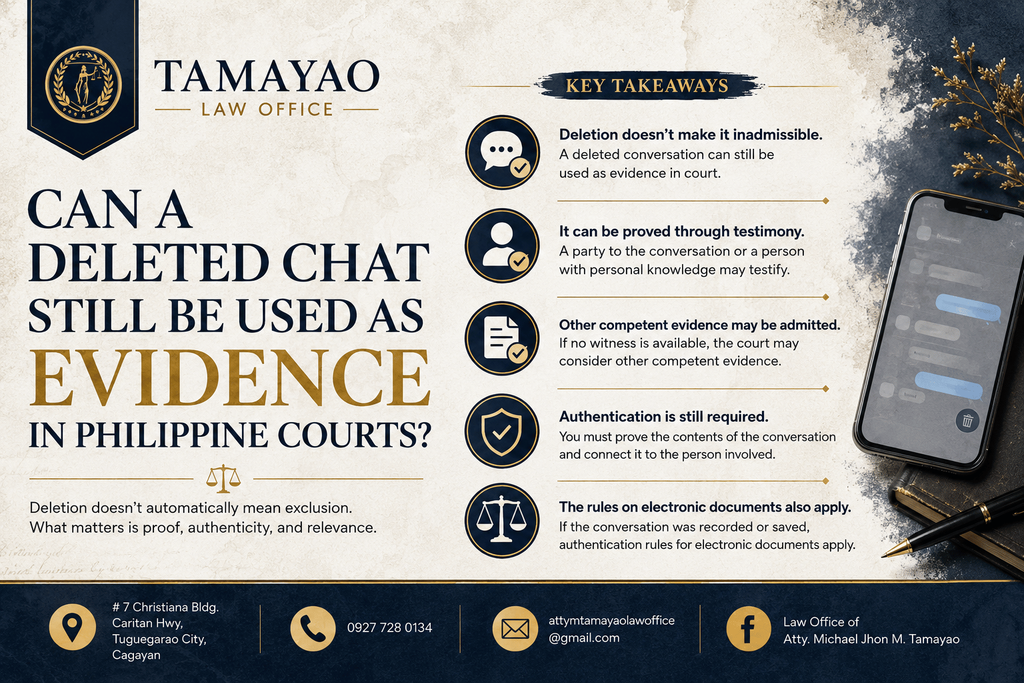
The answer is possibly yes. However, deletion alone does not automatically make the conversation admissible. The person presenting the evidence still needs to establish what the communication contained and reliably connect it to the person who allegedly sent or participated in it.
In an increasingly digital Philippines, this distinction matters. People now use electronic messages for business transactions, personal arrangements, payments, and other important communications. When disputes arise, these conversations may become relevant evidence.
The Legal Doctrine: Deletion Does Not Automatically Destroy the Evidence
Under Section 2, Rule 11 of the Rules on Electronic Evidence (2001), certain electronic communications may be proved through testimony.
The rule covers ephemeral electronic communications—communications that people do not record or retain. These include text messages, telephone conversations, and similar communications.
A party to the communication or another person with personal knowledge may testify about the communication. If such a witness cannot testify, the rules allow other competent evidence, subject to the applicable requirements.
Moreover, when a communication has been recorded or embodied in an electronic document, the rules governing electronic documents and authentication apply.
Therefore, deleting a conversation does not necessarily end the evidentiary issue. Instead, the focus shifts to a more important question:
Can the person presenting the evidence reliably establish what the communication contained and who participated in it?
The supplied case materials include XXX v. People, G.R. No. 274842, October 22, 2025, and Asuncion v. Salvado, A.C. No. 13242, July 5, 2022. However, the materials provided for these cases do not contain sufficient factual or doctrinal discussion to attribute a specific ruling about deleted conversations to either case. Accordingly, this article relies on the electronic-evidence rule expressly provided in the source material rather than adding unsupported case details.
How Can a Deleted Conversation Be Proved?
A deleted conversation presents an evidentiary challenge because the original messages may no longer appear on the device or account.
Nevertheless, the Rules on Electronic Evidence recognize that communications can be proved through appropriate evidence.
Depending on the circumstances described in the source material, relevant proof may include:
- Testimony from a party to the communication. A person who participated in the conversation may testify about what was communicated.
- Testimony from a person with personal knowledge. Someone who personally witnessed or otherwise has direct knowledge of the communication may provide evidence.
- Other competent evidence. When an appropriate witness cannot testify, other competent evidence may potentially establish the communication.
- The recorded electronic communication itself. When the communication exists in an electronic document or recorded form, the applicable rules on electronic documents and authentication govern its presentation.
The central issue remains reliability.
A person cannot simply claim, “There was a message,” and expect the court to accept every detail automatically. The evidence must still connect the alleged communication with the relevant person or event.
Authentication Still Matters
One common mistake involves treating a screenshot, copied message, or description of a deleted conversation as automatically trustworthy.
That approach overlooks an important evidentiary principle reflected in the supplied material: the proponent must establish what the communication contained and reliably connect it to its alleged sender or participant.
For example, suppose someone claims that another person sent a particular message. If the original conversation no longer exists, the court may still consider competent evidence concerning that communication. However, the evidence must provide a reliable basis for determining what the person actually communicated.
Thus, the disappearance of the message does not automatically prove either side’s version of events.
Common Misconceptions
Myth 1: “Once a message is deleted, it can never be used in court.”
Not necessarily.
The Rules on Electronic Evidence allow certain communications to be proved through testimony and other competent evidence. Therefore, deletion does not automatically eliminate every possible means of proving the communication.
Myth 2: “If someone has a screenshot, the court must accept it as genuine.”
Not automatically.
The existence of an image or copy does not, by itself, resolve questions about authenticity. The party presenting the evidence must still establish its reliability and connection to the alleged communication.
Why Digital Evidence Requires Care
Electronic communications can disappear, change, or become difficult to retrieve. Consequently, preserving relevant records can become important when a dispute develops.
A person who believes a conversation may later become relevant should avoid relying solely on memory. Preserving available electronic records and other competent evidence may help establish what actually happened.
At the same time, preservation does not guarantee that evidence will ultimately prove a particular claim. Courts evaluate evidence according to the applicable rules and the circumstances presented before them.
The Main Takeaway
A deleted conversation may still be used as evidence in a Philippine court, but deletion does not automatically establish admissibility or authenticity.
The key question involves proof.
A party seeking to rely on the communication must establish its contents through competent evidence and reliably connect the communication to the alleged sender or participant. When the communication exists as an electronic document, the applicable rules on electronic documents and authentication also come into play.
In short, deleted does not necessarily mean unusable—but neither does a claimed conversation automatically become proven evidence.
For more educational articles concerning Philippine law and practical legal issues, readers may explore the Articles section of Tamayao Law Office, which includes discussions on affidavits, property matters, annulment, evidence-related concerns, and other Philippine legal topics.
A Practical Reminder
Electronic evidence can involve technical and procedural questions that depend heavily on the circumstances of a particular dispute. For specific concerns involving deleted messages, electronic records, or the presentation of evidence, it is best to consult a qualified legal professional.


Leave a Reply