
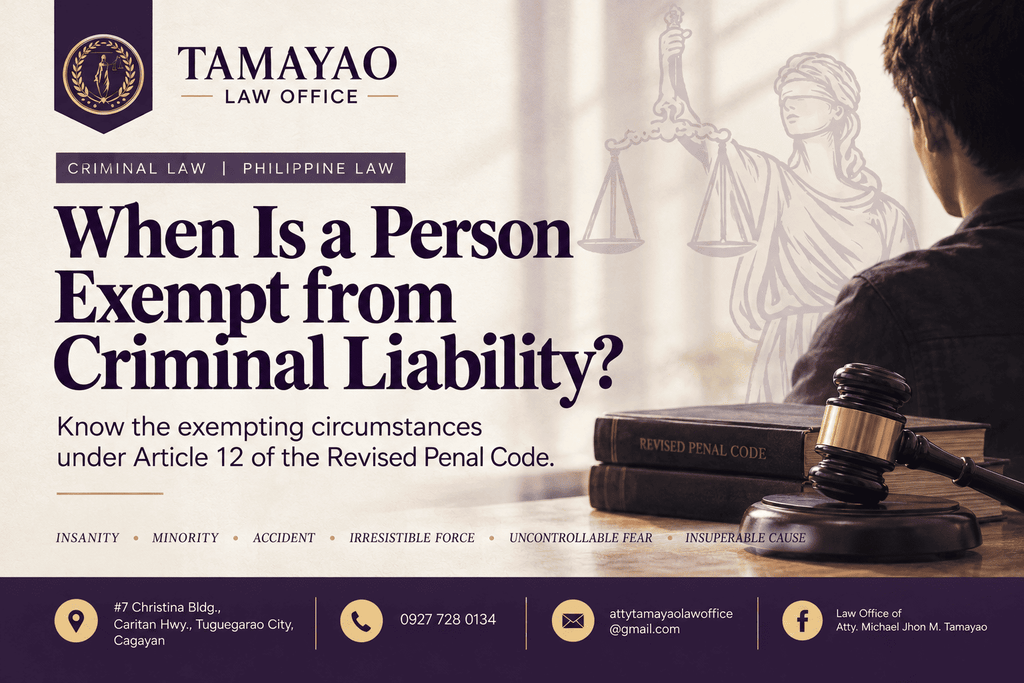
Imagine a person commits an act that would normally constitute a crime. However, circumstances surrounding the act raise an important question: Can the person still be held criminally liable?
Philippine criminal law recognizes situations where a person may be exempt from criminal liability because the law considers that the person lacked the necessary intelligence, freedom of will, or ability to comply with the law when the act occurred.
These situations fall under the exempting circumstances in Article 12 of the Revised Penal Code. However, an exemption does not automatically apply simply because a person claims that one of these circumstances existed. The particular requirements must still be established.
What Are Exempting Circumstances?
Article 12 of the Revised Penal Code recognizes circumstances that may remove criminal responsibility from a person who commits an otherwise punishable act.
In general, the law recognizes circumstances involving:
- Insanity or imbecility;
- Minority;
- Accident while performing a lawful act with due care;
- Irresistible force;
- Uncontrollable fear of an equal or greater injury; and
- Failure to perform an act because of a lawful or insuperable cause.
Nevertheless, exemption from criminal liability does not necessarily remove civil liability. Article 101 of the Revised Penal Code recognizes circumstances where civil liability may still arise.
1. Insanity or Imbecility
Insanity represents one of the most misunderstood exempting circumstances.
A person does not become legally exempt merely because the person has a mental illness, psychiatric diagnosis, intellectual disability, or other form of mental abnormality.
The critical question concerns the person’s mental condition when the act occurred.
In People v. Bañez, the Supreme Court emphasized that the accused must establish legal insanity. Mere evidence of abnormal behavior or diminished mental capacity does not automatically establish the exemption.
More recently, in Ruiz v. People, the Supreme Court recognized that insanity may also appear through clear and convincing circumstantial evidence. The evidence may concern the person’s condition immediately before, during, or after the offense.
The applicable considerations include whether:
- The insanity existed when the crime occurred;
- The condition had medical basis; and
- The condition prevented the person from appreciating the nature, quality, or wrongfulness of the act.
Because the law presumes sanity, the person invoking insanity must establish the circumstance by the required level of proof.
2. Minority
The rules concerning children differ from the original age brackets stated in Article 12 of the Revised Penal Code.
Today, the Juvenile Justice and Welfare Act, as amended, provides the controlling framework.
Generally:
- A child 15 years old or under at the time of the offense is exempt from criminal liability but must undergo an intervention program.
- A child above 15 but below 18 years old is likewise exempt, unless the child acted with discernment.
- Exemption from criminal liability does not automatically eliminate civil liability.
The law therefore considers not only the child’s age but, in appropriate cases, the child’s discernment.
Furthermore, the Supreme Court has recognized that the minority exemption may apply retroactively when doing so benefits the child. Any doubt concerning the child’s age must also be resolved in the child’s favor.
3. Accident While Performing a Lawful Act With Due Care
Not every injury resulting from an act creates criminal liability.
The accident exemption may apply when the person:
- Performs a lawful act;
- Exercises due care;
- Causes the injury purely by accident; and
- Does not act with fault or intent to cause the injury.
However, negligence or lack of proper care can defeat the exemption.
Thus, the fact that a person did not intend the injury does not automatically establish an accident in the legal sense. The circumstances surrounding the act still matter.
4. Irresistible Force
A person may also be exempt when an irresistible force physically compels the person to commit the criminal act.
The force must operate with such intensity that the person has no reasonable opportunity to resist or exercise free will.
Consequently, ordinary pressure, influence, intimidation, or concern about possible consequences does not automatically constitute irresistible force.
The central consideration involves the person’s actual ability to resist the physical compulsion.
5. Uncontrollable Fear of an Equal or Greater Injury
The law also recognizes uncontrollable fear as an exempting circumstance.
This situation involves a person who commits an act because of a compelling fear of suffering an injury equal to or greater than the injury caused by the offense.
The fear must go beyond ordinary anxiety or apprehension. It must become so overwhelming that the person cannot reasonably resist the threatened harm.
This circumstance differs from irresistible force. Irresistible force involves physical compulsion, while uncontrollable fear involves overwhelming psychological compulsion.
6. Lawful or Insuperable Cause
A person may also become exempt when the person fails to perform an act required by law because of a lawful or insuperable cause.
The important consideration is whether the circumstances made compliance legally impermissible or practically impossible.
Ordinary inconvenience, forgetfulness, personal preference, or simple difficulty generally does not establish an insuperable cause.
Common Misconceptions About Exempting Circumstances
Myth: A mental illness automatically exempts a person from criminal liability.
Not necessarily. People v. Bañez and Ruiz v. People demonstrate why the person’s condition at or around the time of the offense matters. A diagnosis alone does not automatically establish legal insanity.
Myth: Exemption from criminal liability means that there can never be any civil liability.
Not necessarily. Philippine law recognizes situations where civil liability may remain despite exemption from criminal liability. This principle also applies to children who fall within the statutory exemption.
The Key Takeaway
Exempting circumstances exist because Philippine criminal law recognizes that certain situations can affect a person’s intelligence, free will, capacity, or ability to comply with the law.
However, a person cannot simply invoke an exempting circumstance without establishing its legal requirements. The applicable requirements depend on the specific circumstance involved.
In particular, insanity requires careful examination of the person’s mental condition at the time of the offense. Likewise, minority, accident, irresistible force, uncontrollable fear, and insuperable cause each have distinct requirements.
For specific concerns involving possible criminal liability or an exempting circumstance, it is best to seek guidance from a qualified legal professional who can evaluate the facts and applicable law.


Leave a Reply