
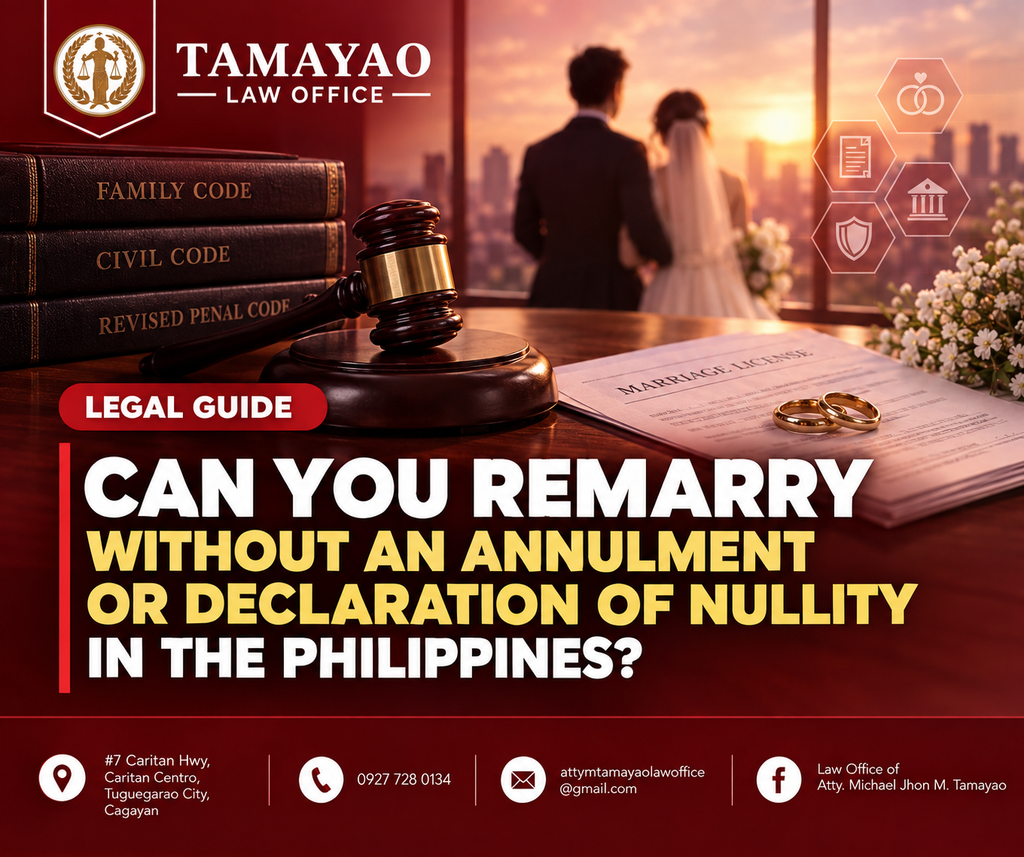
Imagine this: a person has been separated from a spouse for many years. They no longer live together, have built separate lives, and may even believe that the marriage has already ended. Years later, the person meets someone new and wants to get married again.
A common question then arises: Can a person remarry simply because the first marriage has effectively ended in practice?
In the Philippines, the answer generally depends on the legal status of the first marriage. Separation, abandonment, or a personal belief that a marriage was invalid does not, by itself, remove the legal effects of an existing marriage.
The Family Code provides specific rules that govern remarriage. The Supreme Court has also repeatedly emphasized the importance of obtaining the appropriate judicial declaration before contracting another marriage.
The General Rule: A Person Cannot Simply Remarry
Under Philippine law, a person generally cannot contract another marriage while a prior marriage still exists.
The law recognizes different situations depending on what happened to the first marriage. A person may need a final judgment declaring the first marriage void, an annulment decree, or, in certain circumstances, a judicial declaration of presumptive death of an absent spouse.
Therefore, being separated from a spouse does not automatically terminate the marriage.
In Borja-Manzano v. Sanchez (2001), the Supreme Court recognized that even long-term separation and living with another person do not, by themselves, authorize a person to contract another marriage.
The distinction matters because Philippine law does not treat a marriage as legally terminated merely because the spouses have stopped living together.
When the First Marriage Is Valid
If the first marriage remains valid, a subsequent marriage generally becomes void because it takes place while the earlier marriage continues to exist.
However, Article 41 of the Family Code provides an exception involving a spouse who has been absent and is presumed dead.
The law requires specific circumstances before a person may rely on presumptive death for purposes of remarriage.
The requirements include:
- The prior spouse must have been absent for four consecutive years;
- The period becomes two years in cases involving danger of death under Article 391 of the Civil Code;
- The spouse who remains must have a well-founded belief that the absent spouse has died; and
- The spouse who remains must first institute the required summary proceeding for the declaration of presumptive death.
Thus, simply not knowing where a spouse is does not automatically authorize remarriage.
The relevant provision is Article 41 of the Family Code of the Philippines:
Family Code of the Philippines (1987)
When the First Marriage Is Void From the Beginning
Another situation arises when a person believes that the first marriage was void from the beginning.
For example, a person may believe that the marriage lacked a required legal requirement. However, that belief alone does not allow the person to simply contract another marriage.
Article 40 of the Family Code provides the controlling rule for remarriage: the absolute nullity of a previous marriage may be invoked for purposes of remarriage only on the basis of a final judgment declaring that marriage void.
The Supreme Court applied this principle in Marbella-Bobis v. Bobis (2000) and Lasanas v. People (2014).
In practical terms, a person cannot simply make a personal determination that a previous marriage was void and then marry someone else.
A final judicial declaration matters because it establishes the legal status of the earlier marriage before the subsequent marriage takes place.
Marbella-Bobis v. Bobis (2000)
Annulment Is Different From Declaration of Nullity
The terms annulment and declaration of nullity often appear together in everyday conversations, but they refer to different legal situations.
Generally:
- Marriage void from the beginning: The person must obtain a final judgment declaring its absolute nullity before relying on that nullity for remarriage.
- Marriage that remains valid until annulled: The person must obtain an annulment decree.
- Absent prior spouse: The person must comply with the requirements for a judicial declaration of presumptive death under Article 41.
Consequently, a person should not assume that every marital problem automatically makes an annulment unnecessary.
Can Remarriage Lead to Bigamy?
Yes, contracting another marriage while a previous marriage remains legally subsisting may have criminal consequences.
Article 349 of the Revised Penal Code penalizes bigamy, including contracting a second or subsequent marriage before the former marriage has been legally dissolved or before the absent spouse has been judicially declared presumptively dead.
In Lasanas v. People (2014), the Supreme Court emphasized the risk of criminal prosecution when a person contracts another marriage without first obtaining the necessary judicial declaration.
The Court also recognized that good faith ordinarily does not excuse the act.
Furthermore, Genio v. People (2024) recognized that the fact that the second marriage itself is void does not automatically eliminate possible criminal liability under the laws on illegal marriages.
There is, however, an important distinction in criminal proceedings. In Pulido v. People (2021), the Supreme Court recognized that an accused may present competent evidence showing that a supposedly prior or subsequent marriage was void from the beginning when that fact negates an essential element of bigamy.
That principle does not remove the general requirement under Article 40 for persons who seek to remarry on the basis that their prior marriage was void.
Common Misconceptions About Remarriage
Myth 1: “We have been separated for years, so I am already free to marry.”
Not necessarily.
Physical or de facto separation does not, by itself, dissolve a marriage. The legal status of the marriage continues to matter.
Myth 2: “My first marriage was invalid, so I can just remarry.”
Not for purposes of remarriage.
When a person relies on the absolute nullity of a previous marriage, Article 40 requires a final judgment declaring that marriage void.
The Supreme Court’s rulings in Marbella-Bobis and Lasanas reinforce this requirement.
What Should a Person Remember Before Remarrying?
The key points can be summarized simply:
- Separation does not automatically dissolve a marriage.
- A void marriage generally requires a final judgment of absolute nullity before a person may rely on its nullity for remarriage.
- A voidable marriage requires an annulment decree.
- An absent spouse does not automatically become legally presumed dead. The requirements under Article 41 must first be satisfied.
- Remarrying without satisfying the legal requirements may expose a person to consequences, including possible prosecution for bigamy.
- The subsequent marriage may also create legal consequences concerning property and other matters.
In Domingo v. Court of Appeals (1993), the Supreme Court recognized that a person cannot simply treat a marriage as nonexistent for every legal purpose without the necessary judicial determination.
Domingo v. Court of Appeals (1993)
Additionally, Article 44 of the Family Code addresses consequences involving a subsequent marriage when both parties act in bad faith, including the revocation of certain donations and testamentary dispositions made in favor of one another.
The Bottom Line
A person should not remarry simply because they have lived separately from their spouse, because the spouse has abandoned them, or because they personally believe that the first marriage was defective.
Philippine law requires the appropriate legal process before a person may rely on the nullity or termination of a previous marriage for purposes of remarriage.
Depending on the circumstances, this may involve a final judgment declaring absolute nullity, an annulment decree, or a judicial declaration of presumptive death.
For related discussions on annulment, declaration of nullity, and other Philippine family-law matters, readers may explore the Tamayao Law Office Articles.
For specific concerns involving marital status or a contemplated remarriage, it is best to consult a qualified Philippine lawyer who can evaluate the particular facts and applicable documents.


Leave a Reply