
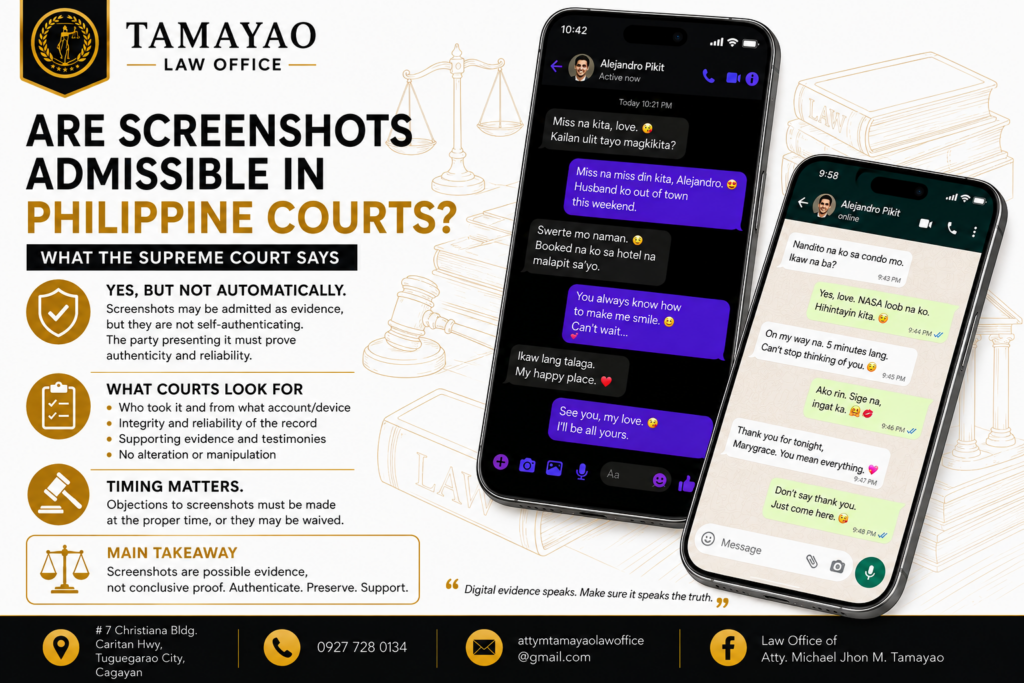
Imagine this situation: someone sends a threatening message through Facebook Messenger, confirms a loan through a text message, or makes an important promise in a chat conversation. Many Filipinos immediately take a screenshot and keep it as proof. Later, a dispute arises, and the question becomes unavoidable: Can a screenshot be used in court?
In today’s digital world, screenshots often become the first form of evidence people save. Conversations, transactions, and notices frequently happen through phones and online platforms. Because of this reality, understanding how Philippine courts treat screenshots has become increasingly important.
The short answer is yes. Philippine courts may admit screenshots as evidence. However, the Supreme Court has clarified that a screenshot is not automatically accepted as true and does not prove itself. The party presenting the screenshot must still establish its authenticity and reliability.
The Supreme Court’s Rule on Screenshots
In Serrano v. Cruz-Angeles (G.R. No. 10985, 2024), the Supreme Court recognized that screenshots may be admitted in evidence. Nevertheless, the Court emphasized that a screenshot is treated as electronic and documentary evidence. Therefore, the person presenting it must prove that it is genuine.
The Court applied the Rules on Electronic Evidence, which treat an electronic document as the functional equivalent of a paper document. In practical terms, this means a screenshot may be considered by the court, but the court will still examine whether it was created, stored, and presented in a trustworthy manner.
Consequently, a screenshot does not become conclusive evidence simply because it appears on a phone screen. The court may still ask: Who took the screenshot? From what account or device did it come? Has anyone altered it?
Reference: Serrano v. Cruz-Angeles (2024) — https://lawphil.net/judjuris/juri2024/jul2024/ac_10985_2024.html
What the Rules on Electronic Evidence Require
Under the Rules on Electronic Evidence, the person presenting electronic evidence bears the burden of proving authenticity. The court may consider several factors, including:
- the reliability of the method used to generate the electronic record;
- the identification of the originator or sender;
- the integrity of the information system where the record was stored; and
- the accuracy of the data reflected in the electronic record.
These rules recognize that digital files can be copied, edited, or manipulated more easily than traditional paper documents. As a result, courts require additional assurance before relying on them.
Reference: Rules on Electronic Evidence (2001) — https://elibrary.judiciary.gov.ph/thebookshelf/showdocs/2/3888
What Can Strengthen a Screenshot?
A screenshot becomes more persuasive when supported by other evidence. Courts generally look for circumstances that confirm its authenticity.
Useful supporting evidence may include:
- testimony from the person who took or received the screenshot;
- testimony from the account holder or sender;
- the original phone, computer, or account from which the screenshot was taken;
- metadata, transaction records, or system-generated records; and
- corroborating documents, such as official records or certifications from a telecommunications provider.
For example, if a person presents a screenshot of a text message, that person may testify that they received the message on a specific date and still possess the phone containing the conversation. Such testimony helps connect the screenshot to a real device and a real communication.
Why Timely Objections Matter
The Supreme Court has also reminded litigants that timing matters when challenging electronic evidence.
In Jade Karla Tan y Cabangon v. People of the Philippines (2026) and Trimillos v. FCash Global Lending, Inc. (2025), the Court explained that a party must object at the proper time, usually when the evidence is formally offered in court. If a party fails to object promptly, the objection may be considered waived.
This rule does not mean every screenshot automatically becomes reliable. Instead, it means courts expect parties to raise objections at the appropriate stage of the proceedings.
References:
- Jade Karla Tan y Cabangon v. People of the Philippines (2026) — https://sc.judiciary.gov.ph/265929-jade-karla-tan-y-cabangon-vs-people-of-the-philippines/
- Trimillos v. FCash Global Lending, Inc. (2025) — https://sc.judiciary.gov.ph/271360-grace-m-trimillos-vs-fcash-global-lending-inc-represented-by-sioly-m-amparo/
A Practical Example: SIM Registration Records
Suppose a person discovers that a SIM registration record shows the wrong birth date. That person may attach a screenshot of the erroneous entry to an affidavit or request for correction. However, the screenshot alone may only show what appeared on the screen at that moment.
A stronger set of documents would include:
- the PSA birth certificate showing the correct birth date;
- valid identification documents; and
- if available, a certification or written confirmation from the telecommunications provider.
This example illustrates an important principle: screenshots often work best as supporting evidence, not as the sole proof of a disputed fact.
Common Misconceptions
Myth 1: “A screenshot is enough to win a case.”
Not necessarily. A screenshot may help prove a fact, but courts usually expect evidence showing that the screenshot is authentic and unaltered.
Myth 2: “If it came from Facebook or Messenger, the court must accept it.”
Courts may admit social media screenshots, but they still evaluate authenticity, reliability, and the surrounding circumstances.
Practical Tips for Preserving Digital Evidence
If a dispute may later reach a government office or a court, consider these practical steps:
- Keep the original device whenever possible.
- Avoid editing or cropping the screenshot.
- Save the full conversation, including dates and names.
- Record when and how you obtained the screenshot.
- Preserve related emails, messages, receipts, or transaction records.
These steps do not guarantee admissibility, but they may help demonstrate authenticity.
The Main Takeaway
Philippine law recognizes screenshots as possible evidence, and courts may admit them. Nevertheless, a screenshot is not self-authenticating. The party presenting it must still prove that it is genuine, reliable, and connected to the facts in dispute.
The Supreme Court’s ruling in Serrano v. Cruz-Angeles and the Rules on Electronic Evidence highlight a simple but important lesson: digital evidence requires proper authentication. Therefore, anyone relying on screenshots should preserve the original records and gather supporting evidence whenever possible.
For more legal information on evidence, affidavits, and practical legal topics, readers may also explore the articles section of Tamayao Law Office: https://tamayaolawoffice.com/category/articles/
For proper guidance regarding electronic evidence, affidavits, or court procedures, it is best to consult a qualified legal professional who can assess the specific facts of the situation.



Leave a Reply