
Many Filipinos ask the same question after a marital relationship breaks down: “How long will an annulment take?” Some hear stories of cases finishing within a year, while others wait several years before receiving a final court decision. Because annulment affects family status, property relations, and future plans, understanding the legal timeline matters.
A common misconception suggests that Philippine law sets a fixed period for annulment cases. However, the Supreme Court has clarified that no single timetable applies to all petitions. The duration depends on several practical and procedural factors.
This article explains the general rule under Philippine law, the stages of an annulment case, and the factors that usually affect the timeline.
For readers who want to learn more about Philippine legal issues, Tamayao Law Office also publishes educational articles at https://tamayaolawoffice.com/category/articles/.
Is There a Fixed Time Limit for Annulment Cases?
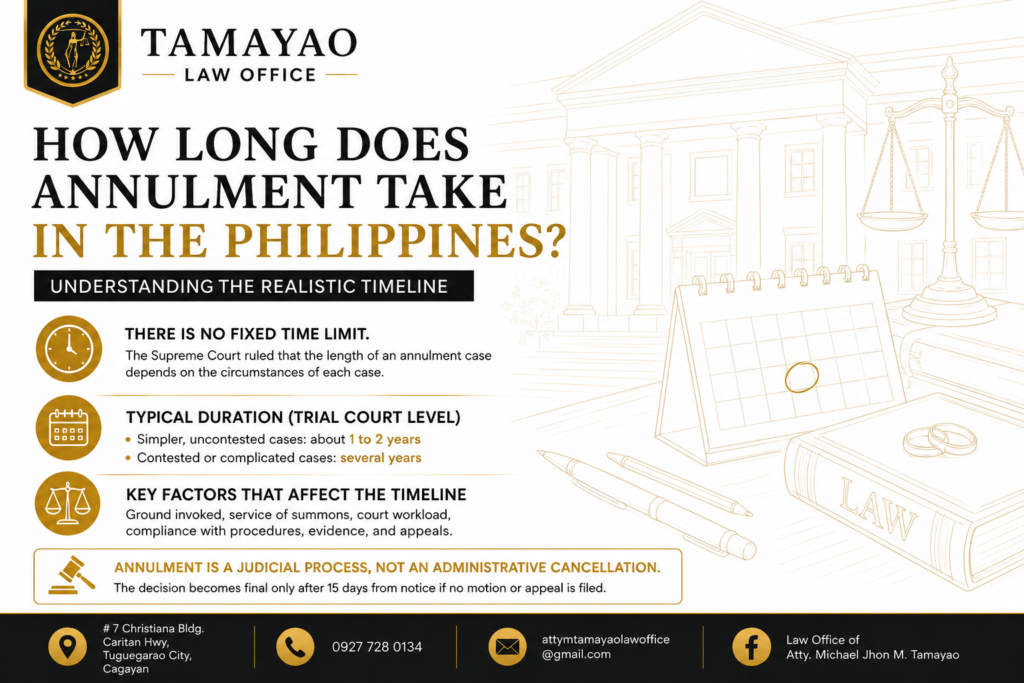
The short answer is no.
In Administrative Matter No. 20-7-96-RTC, In Re: Judicial Audit on Branch 64, Regional Trial Court, Guihulngan City, Negros Oriental, the Supreme Court noted that annulment and declaration of nullity cases do not follow a fixed statutory period. Instead, the length of the proceedings varies depending on the circumstances of each case.
The Court explained that several factors influence the timeline, including:
- the ground invoked in the petition,
- service of summons on the other spouse,
- the court’s caseload,
- compliance with mandatory procedures,
- presentation of evidence, and
- possible appeals.
Therefore, anyone who files an annulment petition should avoid assuming that the case will finish within a specific number of months.
What the Supreme Court Observed About Actual Case Durations
The Supreme Court discussed actual cases during its judicial audit of Branch 64 of the Regional Trial Court in Guihulngan City. In that audit, one declaration-of-nullity case was decided after approximately three years and five months, while another was decided in approximately one year and two months.
These examples do not establish a guaranteed timeline. Instead, they demonstrate that significant variation exists among cases. A relatively straightforward petition may move faster, while a contested case may take much longer.
As a general observation based on the cited records, some uncomplicated cases may finish in roughly one to two years at the trial-court level, whereas contested cases or cases involving additional issues may continue for several years.
Why Annulment Requires Court Proceedings
Philippine law does not allow spouses to cancel a marriage through a simple administrative process. The Rule on Declaration of Absolute Nullity of Void Marriages and Annulment of Voidable Marriages requires judicial proceedings.
Because marriage affects civil status and family relations, the court must examine the evidence before granting a petition. The process therefore involves hearings, notices, and judicial evaluation rather than a mere filing with a government office.
Mandatory Stages That Affect the Timeline
Several procedural stages commonly influence the duration of a case.
Filing of the Petition
The petitioner files the case before the proper Regional Trial Court. The court then reviews the petition and issues the necessary orders.
Service of Summons
The court must notify the respondent spouse. If the respondent cannot be located easily, service of summons may become more complicated and may delay the proceedings.
Participation of the Public Prosecutor
The rules require the participation of the public prosecutor in appropriate stages of the case. Compliance with these requirements forms part of the judicial process.
Mandatory Pre-Trial
The Supreme Court expressly states that pre-trial is mandatory in annulment and nullity cases. The parties must attend and comply with the court’s directives before trial proceeds.
Presentation of Evidence
The petitioner presents witnesses and documentary evidence. If the respondent contests the petition, the court may also receive evidence from the other side.
Decision of the Court
After evaluating the evidence, the court issues its decision.
Finality of Judgment
Even after the court grants the petition, the decision does not become final immediately. Under the Rule, it becomes final only 15 days from notice to the parties, the public prosecutor, and the Solicitor General, provided that no motion for reconsideration, motion for new trial, or appeal is filed.
Issuance of the Decree
The court issues the decree only after compliance with the applicable requirements on liquidation of property under the Rule and the Family Code.
Factors That Commonly Cause Delay
Several practical circumstances often extend the proceedings.
- Difficulty locating the respondent spouse.
- Failure to comply promptly with court requirements.
- Requests for postponement.
- Heavy court dockets.
- Disputes involving property relations.
- Appeals or post-judgment motions.
Conversely, cooperation by the parties and prompt compliance with court directives may help avoid unnecessary delay.
Common Misconceptions About Annulment Timelines
Myth 1: “Annulment always takes exactly one year.”
No Supreme Court ruling supports a fixed one-year period. The Court’s own audit showed different timelines in different cases.
Myth 2: “The marriage becomes void immediately after the judge signs the decision.”
Not yet. The decision becomes final only after the required 15-day period has lapsed without any proper motion or appeal. The court must also issue the decree after compliance with the applicable legal requirements.
A Realistic Expectation
Although every case differs, a practical expectation is more useful than a promise. Based on the Supreme Court’s observations in the cited audit:
- Simpler, uncontested cases: roughly one to two years at the trial-court level.
- Contested cases or cases with additional complications: several years.
Importantly, these are only general estimates. The actual duration depends on the specific facts and procedural developments of the case.
Final Thoughts
Annulment in the Philippines is a judicial process, not an administrative cancellation. Consequently, the timeline varies from case to case. The Supreme Court has recognized that factors such as service of summons, court workload, compliance with mandatory procedures, presentation of evidence, property issues, and appeals all affect the duration of the proceedings.
Understanding this reality helps parties prepare for the process with more realistic expectations. Rather than focusing on a rumored timetable, it is better to understand the required stages and comply promptly with court requirements.
For more educational discussions on Philippine legal topics, visit https://tamayaolawoffice.com/category/articles/.
If you have questions about annulment, declaration of nullity, or family law procedures, it is best to consult a qualified legal professional who can evaluate your specific circumstances.



Leave a Reply