
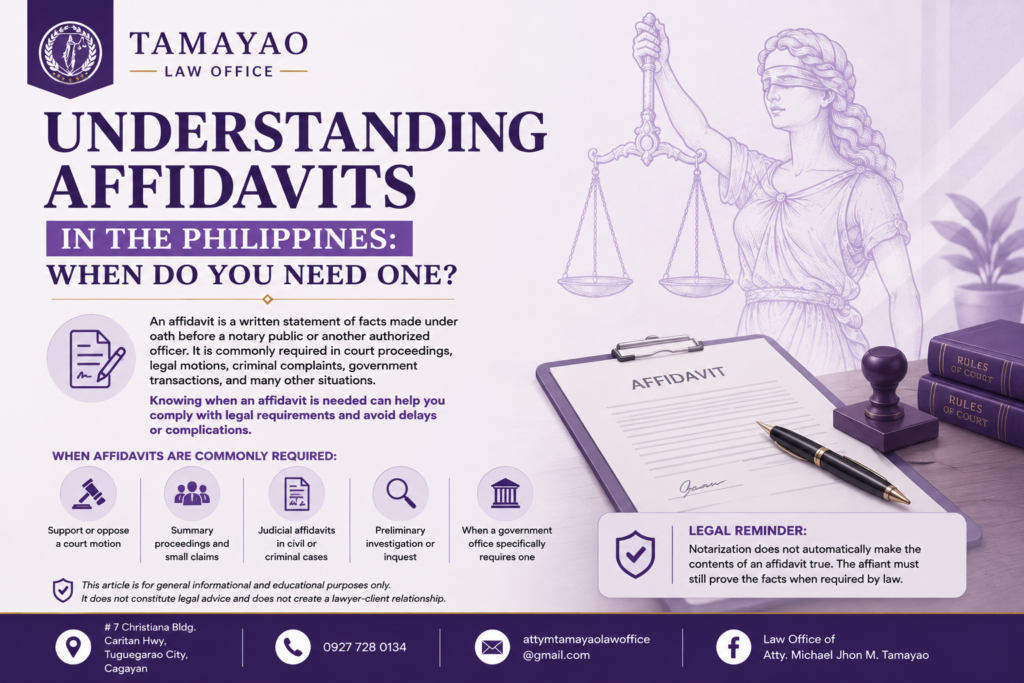
An affidavit often appears in everyday legal and government transactions. Many Filipinos encounter affidavits when they lose an ID, apply for a passport, file a complaint, or submit documents to a court or government office. Because the document is usually notarized, people sometimes assume that it automatically proves everything written in it. However, Philippine law treats affidavits as sworn statements that must follow specific legal rules.
Understanding when an affidavit is required can help individuals avoid delays, rejected applications, or procedural problems.
What Is an Affidavit?
An affidavit is a written statement of facts made under oath before a notary public, prosecutor, judge, or another officer authorized by law to administer oaths. The person who signs the affidavit is called the affiant.
The key feature of an affidavit is the oath. By signing it, the affiant declares that the statements are true based on personal knowledge or authentic records.
Why Affidavits Matter in the Philippines
Affidavits serve several important purposes. They allow a person to present facts in writing, support court filings, initiate criminal complaints, and comply with government requirements. Courts and agencies rely on affidavits because they carry a formal declaration made under oath.
Nevertheless, an affidavit is not a magic document. The affiant must still prove the facts when the law requires testimony or additional evidence.
When Do You Need an Affidavit?
Philippine laws and procedural rules require affidavits in many situations. The controlling question is simple: Does the applicable law, court rule, order, or agency regulation require a sworn statement?
1. To Support or Oppose a Court Motion
Courts may require affidavits in connection with motions, provisional remedies, and special proceedings. One important example is an application for a writ of preliminary attachment.
Under the Rules of Court, the applicant or another person with personal knowledge must state under oath that:
- a sufficient cause of action exists;
- the case falls within the instances allowing attachment;
- there is no other sufficient security for the claim; and
- the amount claimed exceeds applicable legal counterclaims.
The Supreme Court reiterated this requirement in La Filipina Uy Gongco Corporation, et al. v. Harbour Centre Port Terminal, Inc. (2023). The case emphasizes that the affidavit is a required part of the application, not merely an optional attachment.
2. In Summary Proceedings and Small Claims Cases
The Rules on Expedited Procedures in the First Level Courts (2022) require affidavits in summary proceedings and small claims cases.
These affidavits must contain only facts based on:
- the affiant’s direct personal knowledge; or
- authentic records admissible in evidence.
If a party submits inadmissible statements, the court may expunge those portions. Moreover, failure to submit required affidavits may lead to the dismissal of the claim or counterclaim.
In small claims hearings, parties should also bring the original affidavits of their witnesses and supporting documents if they have not previously submitted them.
3. As Judicial Affidavits in Civil or Criminal Cases
The Judicial Affidavit Rule (2012) allows a judicial affidavit to take the place of a witness’s direct testimony in many cases.
A judicial affidavit must:
- use a question-and-answer format;
- explain how the witness acquired personal knowledge;
- identify and authenticate attached documents or objects;
- bear the witness’s signature; and
- include a proper jurat signed by an authorized officer.
Because it functions as direct testimony, the witness may still be cross-examined in court.
4. During Preliminary Investigation or Inquest
Affidavits play a central role in criminal complaints filed with the prosecutor’s office. Common affidavits include:
- complaint-affidavit;
- counter-affidavit;
- reply-affidavit; and
- rejoinder-affidavit.
The 2024 DOJ-NPS Rules on Preliminary Investigations and Inquest Proceedings require these affidavits to be subscribed and sworn before an authorized officer. Supporting witness affidavits and documentary evidence may also be attached.
Importantly, the complaint-affidavit must contain enough supporting evidence to establish prima facie evidence with reasonable certainty of conviction.
5. When a Government Office Specifically Requires One
Many administrative transactions require affidavits, such as matters involving passports, civil registry records, immigration, employment, banking, or insurance.
For example, the Philippine Passport Act of 1996 recognizes situations where an applicant may submit affidavits when certain birth or baptismal records are unavailable.
Because requirements vary, applicants should always check the specific agency’s current rules.
When Is Notarization Required?
Most affidavits must be sworn before an authorized officer, commonly a notary public. The officer administers the oath and signs the jurat.
However, notarization does not automatically make the contents true. Courts may still reject statements that are hearsay, speculative, or unsupported by competent evidence.
What Makes an Affidavit Legally Useful?
A useful affidavit generally contains:
- facts, not conclusions;
- statements based on personal knowledge;
- properly identified attachments; and
- information that the affiant could testify to in court.
The 2019 Amendments to the Rules of Civil Procedure require supporting affidavits to show that the affiant is competent to testify on the matters stated.
Common Misconceptions
Myth 1: “A notarized affidavit is automatically true.”
Not true. Notarization only proves that the affidavit was sworn before an authorized officer. The truthfulness of the statements may still be challenged.
Myth 2: “Anyone can sign an affidavit about what another person told them.”
Generally, no. Affidavits should be based on the affiant’s own knowledge or authentic records. Pure hearsay may receive little or no evidentiary weight.
A Practical Checklist
You will generally need an affidavit when:
- a law, court rule, or agency regulation expressly requires one;
- you are initiating or opposing a legal proceeding through sworn written evidence;
- you are applying for a provisional remedy such as attachment;
- you are submitting witness testimony under the Judicial Affidavit Rule or expedited procedure rules; or
- a government or private institution requires a sworn declaration for a specific transaction.
Before signing any affidavit, read it carefully and confirm that every statement is accurate.
Final Takeaway
Affidavits remain one of the most common legal documents in the Philippines. They help courts, prosecutors, and government agencies receive sworn factual statements efficiently. Nevertheless, the law requires more than a signature and a notarial seal. The affidavit must contain facts based on personal knowledge, comply with the applicable procedural rule, and include any required attachments.
For readers who want to learn more about Philippine legal procedures and practical legal topics, see other articles at Tamayao Law Office Articles .
For proper guidance regarding a specific affidavit requirement or legal proceeding, it is best to consult a qualified legal professional.


Leave a Reply