
Receiving a demand letter can be stressful. Many people immediately assume they have already lost the case, while others ignore the letter because they believe it has no legal effect. Both reactions can create unnecessary legal risks.
In the Philippines, a demand letter often serves as an important step before litigation. It may affect whether a person is already in default, whether the filing of a court action becomes appropriate, and whether the period for filing a legal claim has been interrupted. Therefore, every recipient should treat a demand letter seriously and respond thoughtfully.
This guide explains the immediate steps you should take after receiving a demand letter. It also discusses the legal principles recognized by the Philippine Supreme Court and the Civil Code. Although every situation differs, understanding these general rules helps you make informed decisions before taking further action.
Why a Demand Letter Matters
A demand letter is a formal written communication that asks another person to perform an obligation, pay an amount due, surrender property, or stop a particular act.
Although a demand letter is not the same as a court summons, it can produce important legal consequences.
For example, Article 1155 of the Civil Code provides that a written extrajudicial demand may interrupt the running of the prescriptive period. The Supreme Court applied this principle in Domestic Petroleum Retailer Corporation v. Manila International Airport Authority (2019). Once prescription is interrupted, the period generally begins to run anew from receipt of the demand.
In addition, the Supreme Court emphasized in Goldland Tower Condominium Corporation v. Lim (2024) that, as a general rule, a debtor incurs default only after a judicial or extrajudicial demand, unless the law or the parties’ agreement provides otherwise.
Because of these legal effects, ignoring a demand letter may place you at a disadvantage.
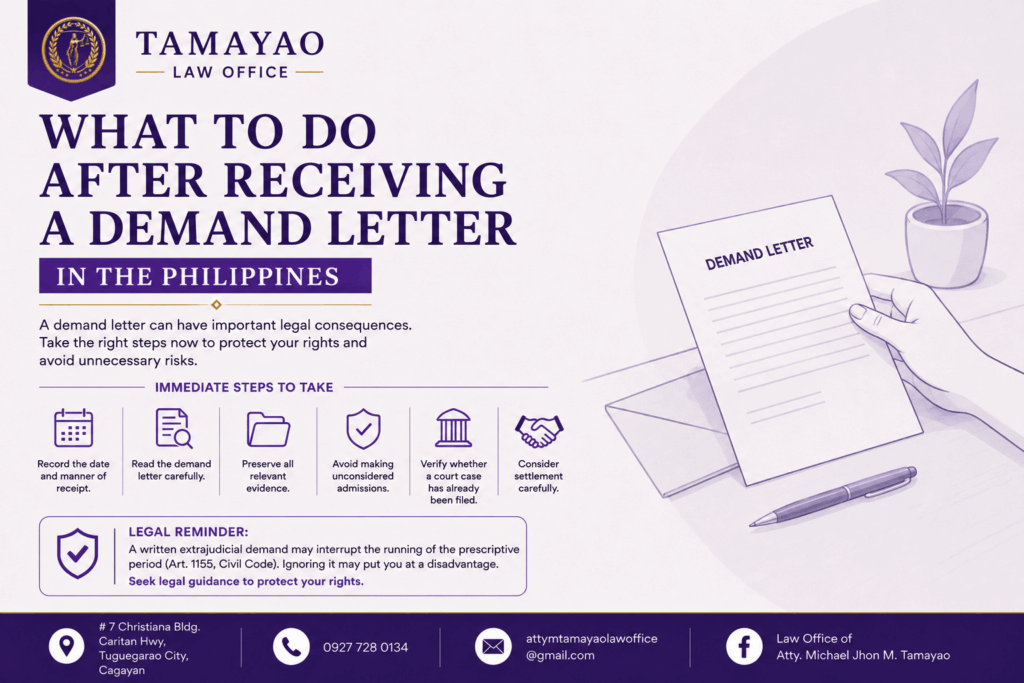
Immediate Steps to Take After Receiving a Demand Letter
1. Record the Date and Manner of Receipt
Immediately note when and how you received the demand letter.
Keep every available proof, including:
- The original envelope
- Registry receipts
- Courier documents
- Email records
- Text messages
- Proof of personal service
These records may become important because legal periods often begin from the date of receipt.
2. Read the Demand Letter Carefully
Do not assume that every statement in the letter is correct.
Instead, carefully verify:
- The identity of the sender and recipient
- The legal and factual basis of the claim
- The amount demanded
- The computation of the amount
- The contract or document being relied upon
- The deadline for compliance
- The action being demanded
- The consequences of non-compliance
Compare every allegation with your own records before making any decision.
3. Preserve All Relevant Evidence
Gather and organize all documents connected with the dispute.
These may include:
- Contracts and amendments
- Official receipts
- Proof of payment
- Bank statements
- Delivery records
- Emails
- Text messages
- Letters
- Photographs
- Videos
- Property titles and related documents
Avoid deleting electronic communications. Written records often become valuable evidence if litigation later becomes necessary.
4. Avoid Making Unconsidered Admissions
Many recipients panic after receiving a demand letter and immediately send messages admitting liability.
Avoid statements such as:
- “I admit the debt.”
- “I will definitely pay everything.”
Likewise, avoid signing:
- Acknowledgments
- Promissory undertakings
- Compromise agreements
- Admissions of liability
without first obtaining proper legal review.
The Supreme Court recognized in Magdiwang Realty Corporation v. The Manila Banking Corporation (2012) that a written acknowledgment may affect prescription under Article 1155 of the Civil Code.
5. Determine Whether the Demand Is Legally Effective
Not every demand letter automatically places a person in default.
Review your contract carefully.
Check whether it contains provisions regarding:
- Waiver of demand
- Notice requirements
- Cure periods
- Acceleration clauses
- Penalties
- Interest
- Proper methods of service
In Planters Development Bank v. Delos Santos (2025), the Supreme Court recognized that where a promissory note expressly waives demand, non-payment may already place the debtor in default even without a prior demand letter.
6. Prepare a Careful Written Response When Appropriate
A written response may become appropriate depending on the circumstances.
The response may:
- Deny the claim
- Dispute the amount demanded
- Request supporting documents
- Ask for an accounting
- Assert payment
- Raise settlement or offset
- Propose payment arrangements without admitting liability
- State that the matter remains under legal review
Use careful language and keep proof that the response was delivered.
7. Verify Whether a Court Case Has Already Been Filed
A demand letter differs from a court summons.
However, you should immediately verify whether the creditor has already filed:
- A collection case
- A foreclosure case
- An ejectment case
- Another civil action
If you receive court papers or summons, follow the deadlines under the 2019 Amendments to the Rules of Civil Procedure, not merely the deadline written in the demand letter.
Generally, an Answer must be filed within 30 calendar days after service of summons, unless the Rules or the court provides otherwise.
8. Consider Settlement Carefully
Settlement often provides a practical solution.
However, negotiate only after determining the actual amount due.
If both parties agree to settle, the written agreement should clearly specify:
- Payment schedule
- Releases
- Interest
- Penalties
- Consequences of future default
Do not assume that verbal negotiations suspend legal deadlines. Continue monitoring all applicable periods unless the parties execute an effective written agreement.
Practical First-Day Checklist
If you receive a demand letter today, consider completing this checklist immediately:
⚖ Practical First-Day Checklist
Immediate Steps After Receiving a Demand Letter
⚖ Legal Reminder
A demand letter may have legal consequences depending on its contents and the applicable law. Completing this checklist can help preserve your rights and organize relevant documents. However, it does not replace legal advice. Consult a qualified lawyer before submitting any written response or making any admission regarding the claim.
- ✔ Scan and preserve the demand letter.
- ✔ Keep proof of receipt.
- ✔ Calendar every stated deadline.
- ✔ Gather contracts and payment records.
- ✔ Preserve emails and text messages.
- ✔ Avoid admissions of liability.
- ✔ Verify whether court proceedings already exist.
- ✔ Seek legal review before responding.
Common Misconceptions
Myth 1: “A demand letter is already a court case.”
No. A demand letter is not a summons. It usually serves as an extrajudicial demand before litigation. Nevertheless, it may still produce important legal effects, so recipients should not ignore it.
Myth 2: “Ignoring a demand letter makes it disappear.”
No. Ignoring the letter does not automatically eliminate the claim. Depending on the facts and applicable law, the sender may still pursue legal remedies. Moreover, the demand itself may affect prescription and issues relating to default.
Conclusion
Receiving a demand letter does not automatically mean you are legally liable. However, it signals that a legal dispute may already exist. Instead of reacting emotionally or ignoring the communication, preserve your records, verify the facts, review the relevant documents, and respond carefully when appropriate.
Understanding the legal consequences of a demand letter helps protect your rights while allowing you to make informed decisions. Early preparation often prevents unnecessary complications later.
For more practical legal guides on Philippine law, explore the articles available at Tamayao Law Office Articles.
Need Guidance?
Every legal dispute presents unique facts and circumstances. If you receive a demand letter or have concerns about your legal rights and obligations, consult a qualified Philippine lawyer who can evaluate your specific situation and provide appropriate legal guidance.


Leave a Reply