
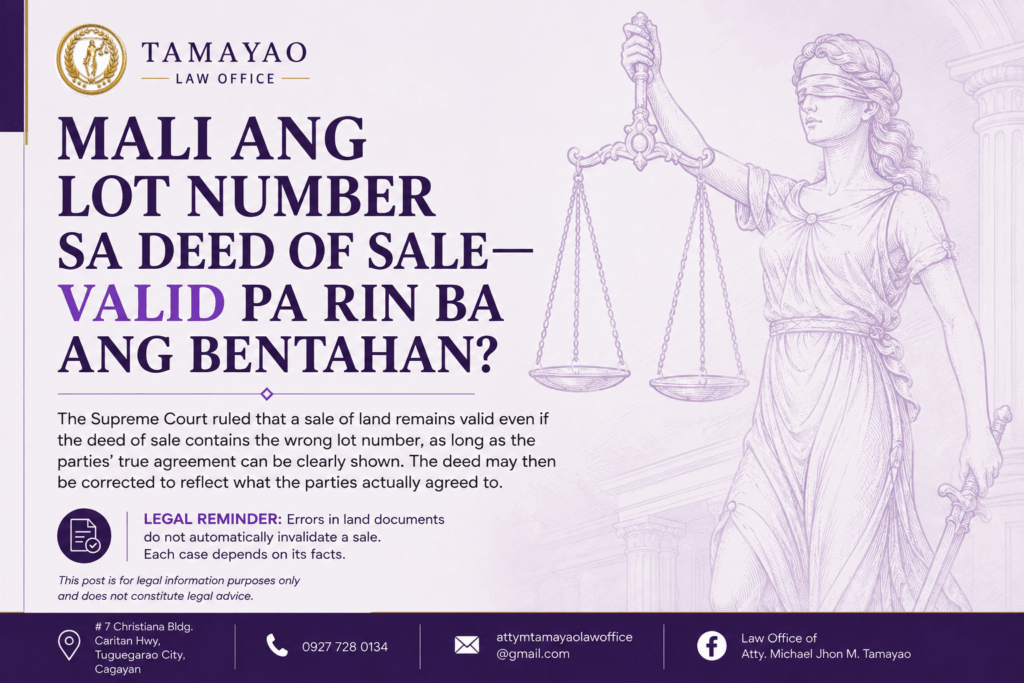
Buying or selling land is one of the most significant transactions a person can make. Naturally, both parties expect the deed of sale to accurately describe the property involved. However, what happens if the document mistakenly states the wrong lot number?
Many people immediately assume that such an error automatically voids the sale. The Philippine Supreme Court recently clarified that this is not always the case. When the evidence clearly shows the property that the parties actually intended to sell and buy, the sale may remain valid even though the deed contains an incorrect lot number.
This ruling reminds property owners, buyers, and sellers that courts examine the parties’ true agreement rather than relying solely on technical descriptions found in the written document.
What Did the Supreme Court Say?
In Abay, et al. v. Young, et al. (G.R. No. 266298, 2025), the Supreme Court emphasized that a buyer does not purchase land solely through its technical lot number. Instead, the buyer acquires the property as it actually exists on the ground, including its visible boundaries, monuments, and improvements.
In the case, the buyers inspected the property before the sale. They identified its actual boundaries, took possession of the land, constructed a perimeter fence, paid real property taxes, and occupied the property for many years.
Despite these circumstances, the deed of sale mistakenly referred to a different lot number.
After examining the evidence, the Supreme Court concluded that the written instrument failed to reflect the parties’ true agreement. The Court recognized that the incorrect lot number resulted from a clerical mistake rather than a different intention to sell another property.
Consequently, the Court held that the deed could be reformed to correctly identify the property while allowing the sale itself to remain valid.
What Is Reformation of an Instrument?
Article 1361 of the Civil Code provides that when a mutual mistake causes a written instrument to fail to express the parties’ real agreement, the instrument may be reformed.
Reformation does not create a new contract. Instead, it corrects the written document so that it accurately reflects what the parties had already agreed upon.
Therefore, an incorrect lot number does not automatically invalidate a sale if the intended property can still be identified and the parties can prove their actual agreement.
When Is Reformation Proper?
Based on Abay, et al. v. Young, et al. (2025), reformation becomes proper when the following requisites exist:
- There was a genuine meeting of the minds between the parties.
- The written instrument failed to express their true intention.
- The discrepancy resulted from mistake, fraud, inequitable conduct, or accident.
The Supreme Court also looked at surrounding circumstances that demonstrated the parties’ true intent, including:
- Inspection of the actual property before the sale;
- Identification of the property’s visible boundaries;
- Actual possession by the buyers;
- Construction of a perimeter fence or other improvements;
- Payment of real property taxes; and
- Long and uninterrupted occupation of the property.
These circumstances supported the conclusion that the incorrect lot number merely reflected a clerical error instead of a different agreement.
Why Does This Ruling Matter?
Property transactions often involve technical descriptions, survey plans, and land registration records. Although accuracy remains essential, honest mistakes may still occur when preparing legal documents.
This decision shows that courts do not automatically invalidate a transaction simply because of an incorrect technical description. Instead, courts examine all available evidence to determine what the parties truly intended.
As a result, individuals involved in property transactions should preserve documents and other evidence that demonstrate the property’s identity and the parties’ actual agreement.
Examples include:
- Inspection records;
- Photographs of the property;
- Sketches or boundary markers;
- Tax declarations and tax payment receipts;
- Evidence of possession;
- Construction of improvements; and
- Other documents showing the property’s identity.
These pieces of evidence may become important if questions later arise regarding the description contained in the deed.
Common Misconceptions
Myth 1: A wrong lot number automatically voids the sale.
Not necessarily.
According to the Supreme Court, a sale may remain valid when the evidence clearly establishes the property that the parties intended to transfer. If the written deed simply contains a clerical mistake, the document may be reformed to reflect the true agreement.
Myth 2: Only the technical description determines what property was sold.
Not always.
The Supreme Court explained that the property’s actual location, visible boundaries, monuments, possession, and improvements also help determine the parties’ true intention. Courts consider these surrounding circumstances together with the written document.
Key Takeaway
Accuracy in preparing land documents remains extremely important. Nevertheless, a clerical error in the lot number does not automatically invalidate a property sale.
Under Article 1361 of the Civil Code and the ruling in Abay, et al. v. Young, et al. (2025), courts may reform a written instrument when it fails to express the parties’ true agreement because of mistake. If credible evidence establishes the property that the parties actually intended to sell and buy, the sale itself may continue to be valid even after correcting the written description.
For buyers, sellers, and property owners, this ruling underscores the importance of documenting every stage of the transaction and preserving evidence that reflects the parties’ genuine intent.
Need Guidance on Property Documents?
Every property transaction involves unique facts and documentation. If you have concerns regarding deeds of sale, land documents, or property transactions, it is best to consult a qualified legal professional who can assess your specific circumstances.
For more legal insights on Philippine laws and Supreme Court decisions, visit:
https://tamayaolawoffice.com/category/articles/



Leave a Reply