

For many entrepreneurs in the Philippines, the sight of a formal letter from the Department of Labor and Employment (DOLE) or a notice from the National Privacy Commission (NPC) triggers an immediate sense of dread. Often, the first instinct is to “call the lawyer” to put out the fire. This reactive stance characterizes the traditional relationship between businesses and legal counsel. However, as the Philippine economic landscape becomes more regulated and competitive, especially for Micro, Small, and Medium Enterprises (MSMEs), this “fireman” approach is proving to be both costly and inefficient.
What if your legal counsel functioned less like an emergency room doctor and more like a strategic architect? By adopting a systems approach and building a “legal engine,” businesses can transform legal compliance from a periodic headache into a sustainable competitive advantage.
Understanding the Systems Approach in Business
A systems approach views a business not as a collection of isolated departments, but as a series of interconnected “engines” working toward a single goal. Whether you are running a 24/7 BPO in Tuguegarao or a retail chain in Metro Manila, your business relies on several core engines: the Human Resources engine, the Sales and Procurement engine, and the Compliance and Governance engine.
When one part of the system fails—for instance, a poorly drafted employment contract—it creates a ripple effect that can stall the entire machine. A systems approach identifies these friction points before they cause a breakdown. Specifically, it seeks to embed legal safeguards directly into the daily operational workflow. Instead of waiting for a problem to arise, the system is designed to prevent the problem from occurring in the first place.
The Power of the “Legal Engine”
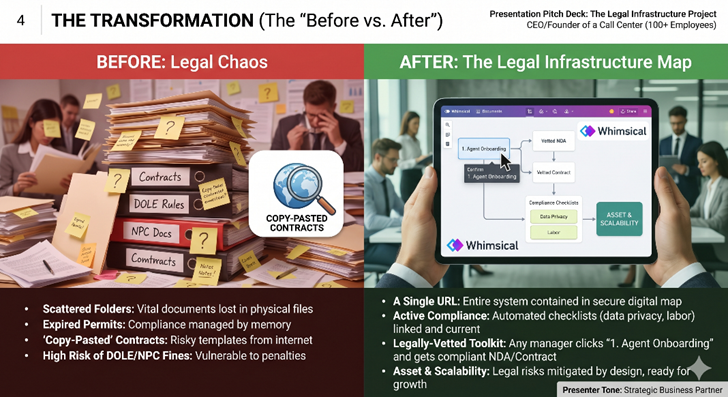
In the context of a legal retainership, building a “legal engine” means creating a centralized, systematized library of legal assets tailored to your specific business model. Imagine a digital map of your operations where every critical step is linked to a vetted legal form, a compliance checklist, or a procedural guideline.
1. Speed and Autonomy
One of the primary benefits of a legal engine is the removal of the “legal bottleneck.” In a traditional setup, a manager might wait days for a lawyer to review a simple Non-Disclosure Agreement (NDA). With a systematized engine, that manager can access a pre-approved, legally sound template instantly. Consequently, the business moves at the speed of the market while remaining within the bounds of Philippine law.
2. Risk Mitigation by Design
Philippine laws, such as the Labor Code and the Data Privacy Act of 2012, are rigorous. For example, the “Twin-Notice Rule” in employee dismissal requires strict adherence to procedural due process. A legal engine includes automated “Notice to Explain” and “Notice of Decision” templates that guide HR managers through the process step-by-step. This structural safeguard significantly reduces the risk of expensive illegal dismissal cases and backwage claims.
3. Creating Scalable Assets
For MSMEs looking to grow, a legal engine is a value-multiplier. When a business is systematized, it becomes more attractive to investors, banks, and potential partners. It demonstrates that the company is “audit-ready” and possesses a mature infrastructure. You are no longer just selling a service; you are presenting a professional, low-risk organization.
Common Misconceptions About Legal Retainers
To appreciate the value of a systems approach, we must first address two common myths that often hinder Philippine business owners.
Myth 1: “Lawyers are only necessary when there is a lawsuit.”
Many owners view legal fees as an “emergency expense.” In reality, the cost of litigation—both in terms of money and time—far exceeds the investment in a proactive retainer. A systems approach focuses on “preventive lawyering.” By the time you reach a courtroom, the system has already failed. A legal engine ensures you stay out of court by maintaining perfect compliance from day one.
Myth 2: “Generic templates from the internet are enough.”
In the age of digital information, it is tempting to download a “Standard Service Agreement” from a global website. However, Philippine jurisprudence is specific and evolving. A contract that is valid in the US or UK might be unenforceable or even illegal under the Civil Code of the Philippines. A custom-built legal engine uses documents specifically mapped to local regulations and the latest Supreme Court rulings.
How the Process Works: From Audit to Engine
Building this infrastructure typically takes six months to a year, but the impact is permanent. The process generally follows these steps:
Integration and Training: Teaching the management team how to use the digital map and the linked resources.
The Diagnostic Audit: Counsel reviews existing contracts, permits, and HR manuals to identify “legal leaks.”
Operational Mapping: Visualizing the business flow (e.g., from recruitment to offboarding) to see where legal safeguards are needed.
Document Construction: Drafting a bespoke toolkit of contracts, forms, and policies.
Conclusion: Moving Toward a Seamless Future
The goal of every business owner is to focus on growth, innovation, and customer satisfaction. You cannot do this effectively if you are constantly bogged down by administrative legal friction or the fear of regulatory penalties. By adopting a systems approach, you transition from a reactive “firefighting” mode to a proactive “architect” mode.
Building a legal engine through a strategic retainership is an investment in the longevity and resilience of your business. It provides the clarity your managers need and the protection your assets deserve. In the modern Philippine business environment, a system isn’t just a luxury—it is the foundation of every successful enterprise.
Take the Next Step
Every business has a unique operational “blueprint.” If you are ready to move beyond standard legal services and begin building your own legal engine, we invite you to explore our library of resources. Visit our presentation to learn more about building your own “Legal Infrastructure Project.”
For specific concerns regarding your business operations, consulting with a qualified legal professional is the best way to ensure your systems are robust and compliant.



Leave a Reply