
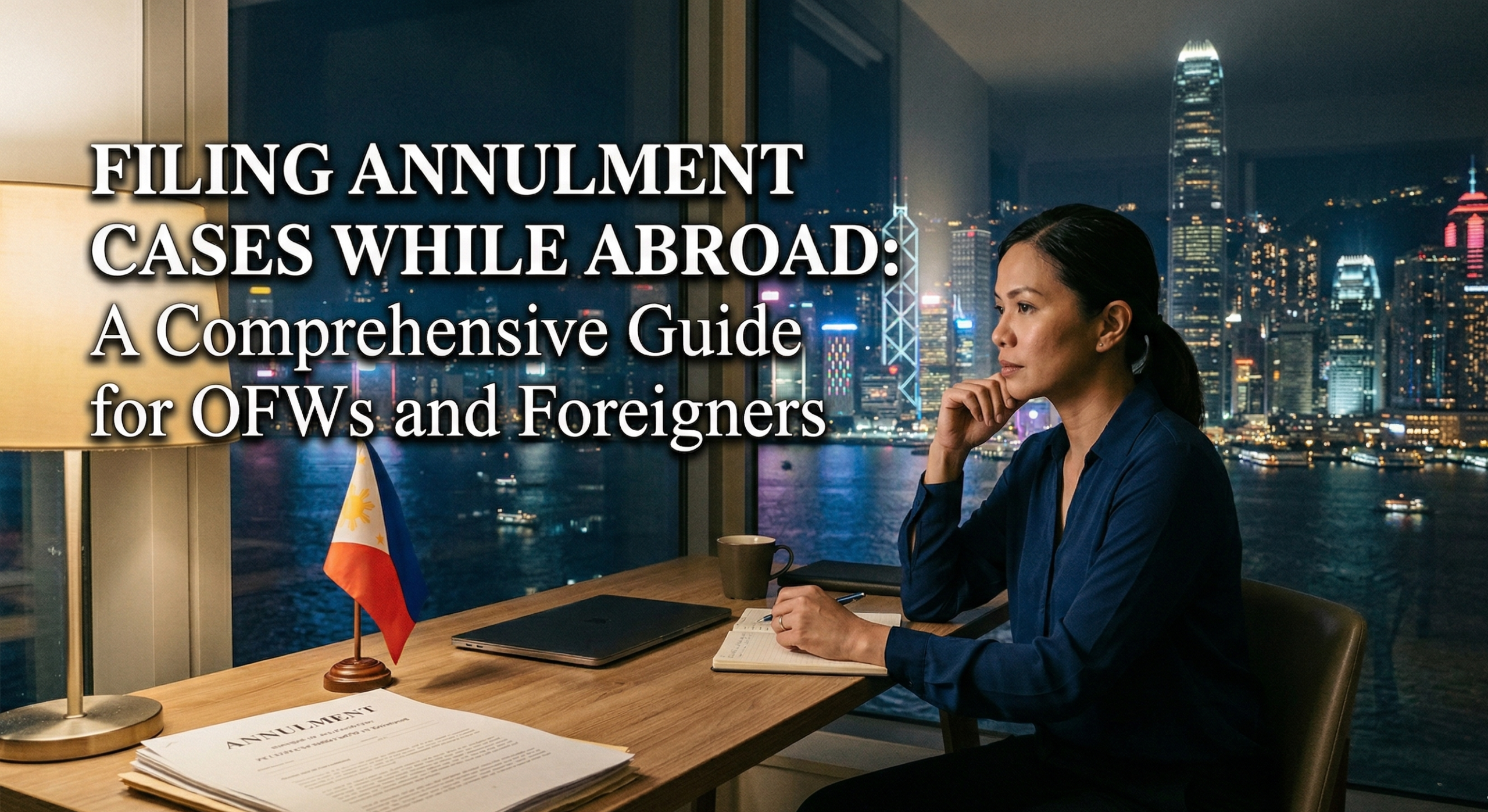
Imagine Maria, a dedicated nurse working in Dubai for the last five years. While she works long shifts to provide for her family, she discovers that her husband in the Philippines has established a second family. Maria wants to move on and legally dissolve her marriage, but she faces a daunting reality: she cannot afford to fly back to Manila, nor can she risk losing her job by taking an extended leave for court hearings. This is a scenario shared by millions of Filipinos in the global diaspora. For a long time, distance felt like an insurmountable barrier to justice.
Fortunately, the legal landscape in the Philippines has evolved significantly. Recent Supreme Court rulings and procedural amendments have streamlined the process for filing annulment cases while abroad, making the judicial system more accessible through technology and flexible residency rules.
The Modern Legal Doctrine: Access to Justice Across Borders
In the past, the “physical presence” and “local residency” requirements often deterred overseas litigants. However, the Supreme Court has recently reaffirmed that the reach of Philippine family law follows its citizens wherever they are.
A landmark development in this area is the case of De Munari v. Asprec, et al. (G.R. No. 262831, April 7, 2025). In this ruling, the Court emphasized the Nationality Principle found in Article 15 of the Civil Code. This principle dictates that Philippine laws relating to family rights, duties, and legal capacity bind Filipino citizens even if they reside in a foreign country.
The De Munari case specifically clarified that Philippine courts have the jurisdiction to declare the nullity of a marriage even if the wedding took place abroad, provided it involves a Filipino citizen. Furthermore, the Court ruled that foreign nationals have the legal standing to file such petitions in the Philippines. This means that if a marriage is void under Philippine law—such as a bigamous marriage—either spouse can seek a judicial declaration of nullity regardless of their nationality or where they currently live.
Key Elements and Requisites for Filing from Abroad
To successfully initiate a petition while overseas, you must comply with the 2023 Amendments to A.M. No. 02-11-10-SC. These amendments specifically addressed the logistical hurdles of venue and residency. Here are the essential conditions required by law:
Verified Petition: You must file a petition that details the complete facts of your case. For instance, if you cite psychological incapacity, you must describe its manifest signs.
Consular Authentication: You must personally sign the verification and certification against forum shopping. Because you are abroad, a Philippine consular officer must authenticate these documents.
Proof of Residency: The 2023 amendments establish specific proof for “habitual residence.” You must provide the exact attachments required by the updated rules to establish your residency status.
Flexible Venue Rules: If both spouses live abroad, you may choose to file where either party habitually resides or where you last lived together in the Philippines. However, if only you are abroad, the case generally proceeds where the respondent resides.
Counsel’s Sworn Statement: Your lawyer may be required to submit a sworn statement as prescribed by the latest Supreme Court guidelines for overseas litigants.
Motion for Videoconferencing: Remote hearings are now an available option. Therefore, you may file a motion to testify via videoconferencing to avoid the cost and necessity of international travel.
Common Misconceptions About Overseas Annulments
Many OFWs hesitate to start the process because of persistent myths. Let’s correct two of the most common ones:
Myth 1: You must fly back to the Philippines to testify in court. The Reality: The Supreme Court has institutionalized virtual hearings. Under the updated guidelines for videoconferencing, overseas litigants can participate in court proceedings remotely. While the court cannot compel you to testify via video from abroad, it is the preferred mode to ensure a speedy and inexpensive disposition of the case. You only need to file a written motion at least seven calendar days before the hearing.
Myth 2: A foreign divorce decree is automatically recognized in the Philippines. The Reality: While a foreign divorce might be valid in the country where it was granted, it does not automatically change your civil status in the Philippines. A Filipino spouse must still file a Petition for Judicial Recognition of Foreign Divorce to be legally allowed to remarry under Philippine law. This is a separate but equally important judicial process.
Conclusion
The evolution of Philippine law reflects a deeper understanding of the transnational lives of many Filipinos. With the 2023 Amendments and the landmark De Munari ruling, the doors of the Family Court are now open to those who serve the country from afar. You no longer have to choose between your livelihood abroad and your right to legal clarity at home. By utilizing tools like the Consularized Affidavit of Residency and videoconferencing, you can pursue a new beginning without the burden of constant international travel.
For proper guidance on navigating these requirements, it is best to consult with a legal professional who understands the specific needs of overseas litigants.
For more insights on family law and other legal topics in the Philippines, you may visit our Article Category Page.


Leave a Reply