
Marriage carries legal, personal, and social consequences. However, some marriages encounter serious problems that lead one spouse to consider annulment. Many Filipinos hear stories about annulment cases from friends, relatives, or social media. Unfortunately, these stories often create confusion about how the process actually works.
Before filing a case, it is important to understand that annulment is not simply an agreement between spouses. Philippine law treats marriage as a matter of public interest. As a result, courts apply strict rules and procedures before they grant a decree of annulment.
This article explains the legal framework governing annulment in the Philippines, the safeguards established by law, and common misconceptions that often mislead the public.
Why Annulment Cases Receive Special Treatment Under Philippine Law
Unlike ordinary civil cases, annulment proceedings involve not only the spouses but also the State.
The Family Code recognizes marriage as an institution that affects society. Consequently, courts cannot dissolve a marriage merely because both parties want to end it.
Article 48 of the Family Code requires the participation of the public prosecutor to ensure that the parties do not collude or fabricate evidence. The law also prohibits courts from rendering judgment based solely on a stipulation of facts or a confession of judgment.
The Supreme Court reinforced these principles through the Rule on Declaration of Absolute Nullity of Void Marriages and Annulment of Voidable Marriages (A.M. No. 02-11-10-SC). This special rule establishes the exclusive procedure for annulment and nullity cases. It emphasizes personal verification of petitions, strict compliance with procedural requirements, and active State participation throughout the proceedings.
Because of these safeguards, annulment cases require careful preparation and proper presentation of evidence before the court
The Legal Doctrine: Annulment Is Not a Simple Agreement Between Spouses
Many people assume that if both spouses agree to end their marriage, the court will automatically approve the request. Philippine law does not allow such a shortcut.
The Supreme Court’s special rules recognize that marriage affects public policy. Therefore, courts must independently determine whether legal grounds exist and whether the evidence supports the petition.
Moreover, the 2019 Amendments to the Rules of Civil Procedure prohibit default judgments in annulment, declaration of nullity, and legal separation cases. Even if the respondent fails to answer the petition, the court must still require proof of the material allegations.
In other words, the petitioner must establish the facts through competent evidence. The court cannot rely solely on admissions, silence, or mutual agreement between the parties.
Key Requirements and Procedural Safeguards
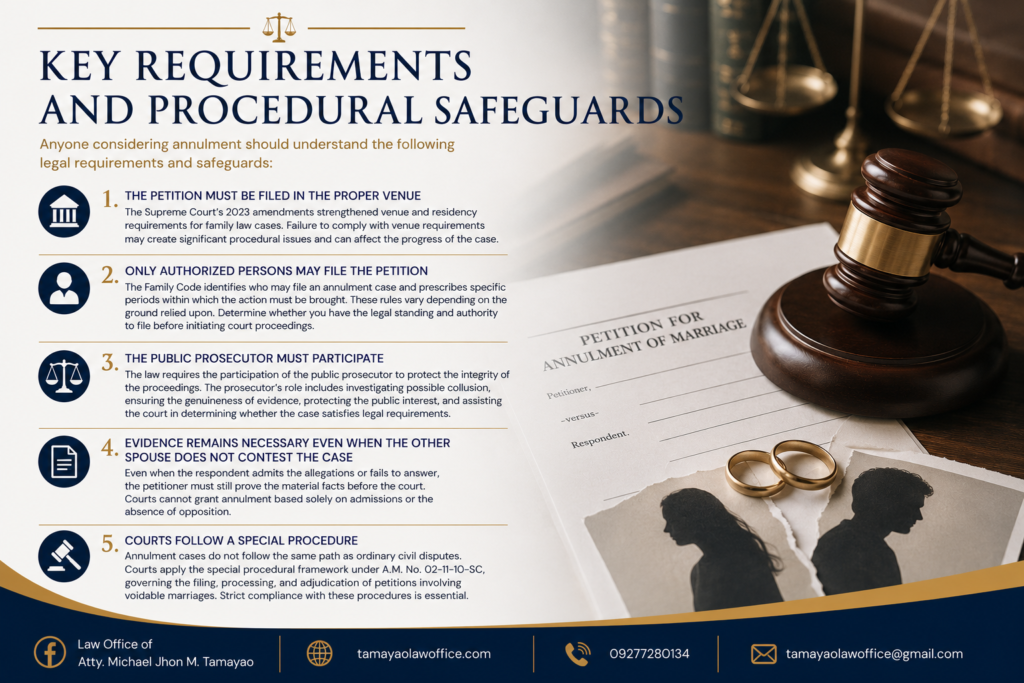
Anyone considering annulment should understand the following legal requirements and safeguards:
1. The Petition Must Be Filed in the Proper Venue
The Supreme Court’s 2023 amendments strengthened venue and residency requirements for family law cases.
Courts require compliance with these rules before they proceed with the petition. The amendments also provide guidance for situations where one or both parties reside abroad.
Failure to comply with venue requirements may create significant procedural issues and can affect the progress of the case.
2. Only Authorized Persons May File the Petition
The Family Code identifies who may file an annulment case and prescribes specific periods within which the action must be brought.
These rules vary depending on the ground relied upon. Therefore, parties should determine whether they possess the legal standing and authority to file before initiating court proceedings.
3. The Public Prosecutor Must Participate
The law requires the participation of the public prosecutor to protect the integrity of the proceedings.
The prosecutor’s role includes:
- Investigating possible collusion between the spouses;
- Ensuring that evidence remains genuine and reliable;
- Protecting the public interest involved in marriage cases; and
- Assisting the court in determining whether the case satisfies legal requirements.
This requirement reflects the State’s interest in preserving the sanctity of marriage unless the law clearly justifies annulment.
4. Evidence Remains Necessary Even When the Other Spouse Does Not Contest the Case
A common misconception involves uncontested petitions.
Even when the respondent admits the allegations or fails to answer, the petitioner must still prove the material facts before the court.
The Rules of Civil Procedure expressly prohibit courts from granting annulment based solely on admissions or the absence of opposition.
5. Courts Follow a Special Procedure
Annulment cases do not follow the same path as ordinary civil disputes.
Instead, courts apply the special procedural framework established under A.M. No. 02-11-10-SC. This framework governs the filing, processing, and adjudication of petitions involving voidable marriages.
Consequently, strict compliance with procedural requirements remains essential throughout the proceedings.
Common Misconceptions About Annulment
Myth #1: “If Both Spouses Agree, the Court Will Automatically Grant the Annulment.”
This belief is incorrect.
Even when both parties agree, the court must examine the evidence and determine whether the legal requirements exist. The prosecutor must also ensure that no collusion occurred.
Therefore, mutual agreement alone does not guarantee a favorable judgment.
Myth #2: “If the Other Spouse Does Not Appear in Court, the Case Automatically Succeeds.”
This misconception also lacks legal basis.
Philippine procedural rules do not allow default judgments in annulment cases. The petitioner must still present sufficient evidence to prove the allegations.
As a result, the absence of the respondent does not automatically lead to annulment.
Why Proper Legal Guidance Matters
Annulment proceedings involve both substantive and procedural requirements. Venue rules, filing requirements, evidentiary standards, and State participation all affect the outcome of a case.
Furthermore, the Supreme Court continues to refine procedural requirements, including rules involving residency and venue compliance.
Because each case presents unique circumstances, individuals should understand the applicable legal framework before taking action.
For related legal insights, readers may also explore articles available at https://tamayaolawoffice.com/category/articles/.
Conclusion
Annulment in the Philippines involves far more than the decision of two spouses to end their marriage. Philippine law treats marriage as a matter of public interest. Consequently, courts require strict compliance with legal and procedural requirements before granting a decree of annulment.
The Family Code, the Rules of Civil Procedure, and the Supreme Court’s special rules collectively ensure that courts carefully examine every petition. They also require State participation to prevent collusion and protect the integrity of the judicial process.
Understanding these safeguards helps individuals set realistic expectations and appreciate the seriousness of annulment proceedings.
Need Guidance Regarding Annulment?
If you have questions about annulment, declaration of nullity, or other family law concerns, it is best to consult a qualified legal professional who can explain how the law applies to your specific circumstances.


Leave a Reply