
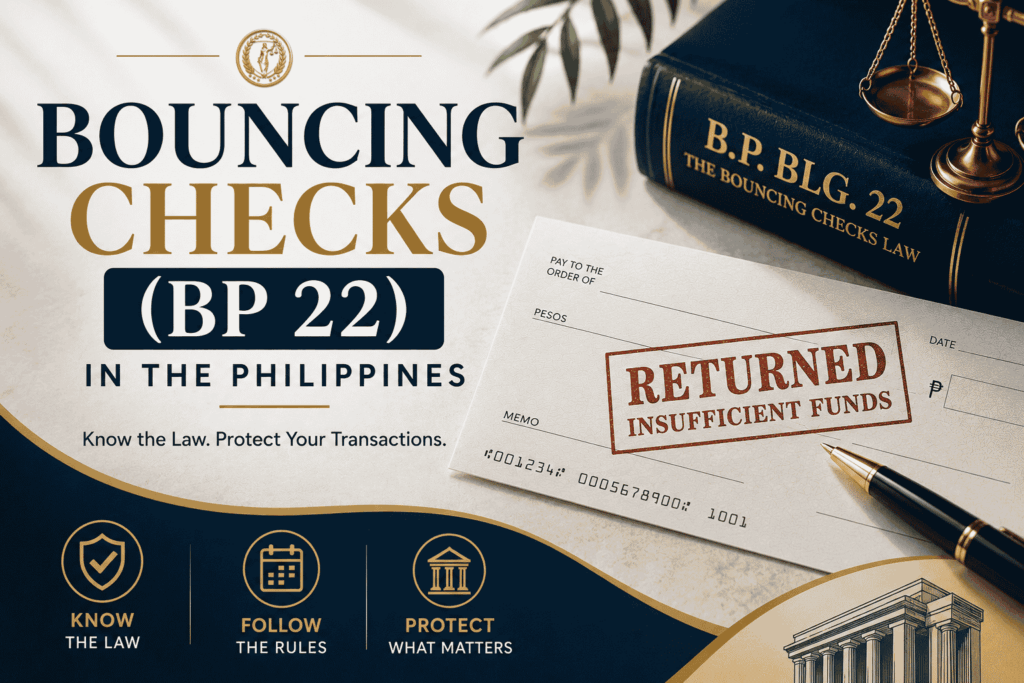
Checks remain a common mode of payment in business and personal transactions across the Philippines. Many people accept checks because they expect the issuing bank to honor them on the due date. However, problems arise when a bank refuses to pay because the account has insufficient funds or has already been closed.
When this happens, many people immediately assume that the issuer automatically becomes criminally liable. The law, however, requires more than the mere dishonor of a check.
Batas Pambansa Blg. 22, also known as the Bouncing Checks Law, sets specific legal requirements before criminal liability may arise. Likewise, the Supreme Court has clarified that procedural safeguards—particularly the requirement of a written notice of dishonor—play a crucial role in every prosecution under the law.
Understanding these rules helps both check issuers and recipients protect their rights and avoid unnecessary legal disputes.
Understanding B.P. Blg. 22
B.P. Blg. 22 penalizes the making, drawing, and issuance of a check when the issuer knows, at the time of issuance, that there are insufficient funds or credit with the bank. If the bank subsequently dishonors the check, the issuer may incur criminal liability under Section 1 of the law.
Upon conviction, the court may impose:
- Imprisonment ranging from 30 days to one (1) year;
- A fine of up to double the amount of the check, not exceeding ₱200,000; or
- Both imprisonment and a fine, depending on the court’s discretion.
The purpose of the law is to preserve public confidence in checks as reliable commercial instruments. Consequently, it discourages the issuance of worthless checks that undermine trust in financial transactions.
What Has the Supreme Court Said?
The Supreme Court has consistently emphasized that compliance with the requirements of B.P. Blg. 22 is essential before criminal liability may attach.
In Oh v. Court of Appeals, et al. (G.R. No. 125297, June 6, 2003), the Court ruled that the prosecution must prove that the accused actually received a written notice of dishonor. The issuer must also receive an opportunity to pay the amount of the check or make arrangements for payment within five (5) banking days after receiving the notice. Without proof of receipt of the written notice, the prosecution cannot establish criminal liability under B.P. Blg. 22. The Court further clarified that the notice requirement still applies even if the bank dishonored the check because the account had already been closed.
Similarly, in Abarquez v. Court of Appeals, et al. (G.R. No. 148557, August 7, 2003), the Supreme Court reiterated that written notice of dishonor and the issuer’s failure to pay or make arrangements within five banking days are indispensable elements of a successful prosecution. The Court also explained that payment made before receiving the notice of dishonor constitutes a complete defense.
Furthermore, the Court described B.P. Blg. 22 as a malum prohibitum offense. This means that the law punishes the prohibited act itself. Therefore, the reason why the check was issued generally does not determine criminal liability.
Essential Elements of a B.P. Blg. 22 ViolationEssential Elements of a B.P. Blg. 22 Violation
For criminal liability to arise under the Bouncing Checks Law, the prosecution must establish the following:
- The accused made, drew, or issued a check.
- The accused knew that there were insufficient funds or credit when the check was issued.
- The bank subsequently dishonored the check.
- The issuer received a written notice of dishonor.
- The issuer failed to pay the amount of the check or make satisfactory arrangements within five (5) banking days after receiving the written notice.
Each of these elements serves an important purpose. Consequently, the absence of any required element may prevent a conviction.
Common Misconceptions About Bouncing Checks
Myth #1: A dishonored check automatically results in criminal liability.
Not always.
While the dishonor of a check is an important requirement, the prosecution must still prove that the issuer received the required written notice of dishonor and failed to pay within the five-day period. As the Supreme Court explained in Oh and Abarquez, failure to prove receipt of the notice is fatal to the prosecution’s case.
Myth #2: The purpose of the check determines whether B.P. Blg. 22 applies.
This is also incorrect.
The Supreme Court has explained that B.P. Blg. 22 is a malum prohibitum offense. Accordingly, the reason for issuing the check generally does not excuse liability if the legal requirements of the statute are otherwise present.
Practical Tips for Check Issuers and Payees
To reduce the risk of legal disputes involving checks, consider the following practical measures:
- Issue checks only when sufficient funds or available credit exist.
- Keep copies of issued and received checks.
- Monitor bank balances regularly.
- Promptly address any notice of dishonor received from the bank or the payee.
- Maintain complete records of payments and communications.
- Seek legal guidance immediately if a dispute involving a dishonored check arises.
Taking these precautions promotes responsible financial transactions and may help prevent avoidable litigation.
Conclusion
B.P. Blg. 22 protects the integrity of checks as valuable payment instruments in the Philippines. However, criminal liability does not arise merely because a check bounces.
The law requires compliance with specific legal elements, including proof that the issuer received a written notice of dishonor and failed to pay within five banking days. As the Supreme Court clarified in Oh v. Court of Appeals and Abarquez v. Court of Appeals, these requirements protect both the payee’s interests and the issuer’s right to due process.
Understanding these rules enables individuals and businesses to make informed decisions whenever they issue or accept checks.
Need Guidance Regarding a Bouncing Check?
Every legal dispute involves unique facts and circumstances. If you have concerns about a dishonored check or your rights and obligations under B.P. Blg. 22, it is best to consult a qualified legal professional who can evaluate your specific situation.
Related Articles
Continue learning about Philippine laws and legal updates by visiting:
https://tamayaolawoffice.com/category/articles
Leave a Reply