
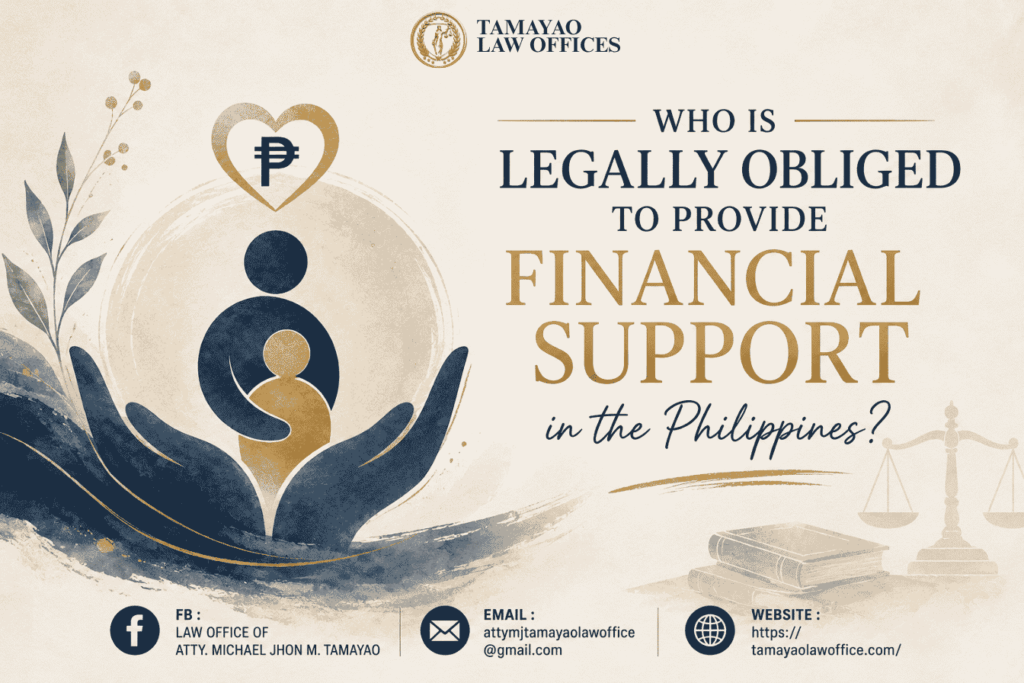
Families face difficult financial realities every single day. A sudden illness might strike an elderly parent. A child could begin preparing for college enrollment. A spouse might suddenly leave the family home. In these trying times, distressed family members frequently wonder who carries the legal responsibility to provide financial assistance.
Financial disputes often trigger intense emotional stress and complex legal challenges within Filipino families. Consequently, understanding your exact legal rights and responsibilities brings much-needed clarity to an otherwise confusing situation. Philippine law strictly regulates these family obligations. Let us explore the specific rules governing financial support to help you navigate these sensitive matters effectively.
The Core Legal Doctrine: Mutual Family Obligations
The Family Code of the Philippines establishes the definitive rules regarding legal support. The law imposes a mutual and mandatory obligation upon specific family members to financially assist one another. Importantly, courts apply these statutory rules with careful consideration of each family’s unique financial realities.
The law views support as a fundamental right necessary for human survival. Therefore, lawmakers designed the Family Code to ensure that vulnerable family members do not suffer when their relatives possess the financial capacity to help. The Supreme Court consistently upholds these principles in various rulings.
What Does “Support” Actually Cover?
Many people mistakenly believe that legal support only pays for daily meals. However, the Family Code provides a comprehensive definition of what financial support covers. According to the law, support includes everything indispensable for human life.
Specifically, the law requires obligors to provide for the following necessities:
- Sustenance: This covers daily food and basic groceries necessary for survival.
- Dwelling: This includes rent payments or the provision of a safe place to live.
- Clothing: This guarantees access to appropriate everyday wear.
- Medical Attendance: This addresses hospital bills, medicines, and routine healthcare needs.
- Education: This secures tuition fees, school supplies, and related learning expenses.
- Transportation: This allows the individual to travel safely for essential daily activities.
Crucially, the law limits this obligation based on financial reality. Courts will ensure that the required support remains consistent with the family’s actual financial capacity.
Who Bears the Legal Obligation to Support Whom?
The Family Code creates a strict hierarchy of individuals who must financially assist one another. The law obliges the following relatives to provide support to the whole extent defined by law:
- Spouses: Married couples owe mutual financial support to one another.
- Legitimate Ascendants and Descendants: Parents, grandparents, and children carry reciprocal obligations.
- Parents and Legitimate Children: This obligation extends to the legitimate and illegitimate children of the latter.
- Parents and Illegitimate Children: The law also covers the legitimate and illegitimate children of the latter.
- Legitimate Brothers and Sisters: This includes siblings of both full and half-blood.
Furthermore, Philippine law extends this obligation beyond legitimate relationships. Even siblings who are “not legitimately related” must support each other. However, a significant exception exists for illegitimate siblings. The law removes this obligation when the sibling claiming support reaches legal age, provided that their financial need stems from a cause imputable to their own fault or negligence.
How Courts Handle Multiple Obligors
Sometimes, the obligation to provide financial assistance falls on two or more persons simultaneously. For example, several working siblings might share the responsibility of supporting an elderly parent. In these scenarios, the law divides the financial burden in proportion to each obligor’s respective resources.
Urgent situations frequently arise where the claimant cannot wait for a lengthy financial assessment. Recognizing this reality, the judge holds the power to order one specific person to furnish the support provisionally. Afterward, the person who advanced the funds retains the right to demand reimbursement from the other responsible relatives.
The Supreme Court Ruling: Support Judgments Are Never Fina
Legal professionals and litigants often assume that a court decision permanently locks in a specific monetary amount. However, the Supreme Court clearly dismantled this notion in the landmark case of Wilfredo A. Ruiz v. AAA (G.R. No. 231619, November 15, 2021).
In this significant ruling, the Supreme Court declared that a judgment on support never attains true “finality” in the sense of becoming unchangeable. Financial circumstances inevitably fluctuate over time. Children grow older and incur higher educational expenses. Conversely, the person providing support might lose a job or suffer a significant business setback.
Because life changes constantly, the Supreme Court allows courts to increase or decrease the mandated amount whenever circumstances warrant a modification. Additionally, judges can even adjust the demandability of the support if the situation drastically shifts. This dynamic approach ensures that the law remains fair, practical, and responsive to the actual needs and capacities of the family members involved.
Common Misconceptions About Financial Support
Legal myths often cause unnecessary panic among family members. Let us correct two of the most prevalent misconceptions regarding financial support in the Philippines.
- Myth 1: Court decisions on child support are permanently fixed.
- Fact: As established in Ruiz v. AAA, courts never consider support judgments unchangeable. Litigants can always file a motion to increase or decrease the amount if they can prove a substantial change in their financial capacity or the claimant’s needs.
- Myth 2: Only parents carry the legal obligation to provide support.
- Fact: The Family Code explicitly lists spouses, legitimate ascendants, descendants, and even siblings as primary obligors. If a parent cannot provide support, the legal obligation may shift to grandparents or siblings depending on the specific circumstances.
Conclusion
Understanding the rules on financial support empowers families to handle disputes with dignity and clarity. The Family Code strictly identifies who must provide assistance, while also outlining exactly what that support must cover. Furthermore, landmark jurisprudence like Ruiz v. AAA guarantees that courts retain the flexibility to adjust these obligations as life circumstances inevitably change. Ultimately, the law seeks to balance the critical needs of the vulnerable with the realistic financial capacity of the obligor.
Call to Action
Family disputes require careful navigation and a deep understanding of your unique circumstances. Reading general legal information serves as an excellent first step, but it cannot replace a thorough review of your specific situation. If you want to explore more insights on family and civil law, please feel free to browse our comprehensive collection of legal articles. For proper guidance on your specific legal concerns, it is always best to consult with a qualified legal professional.


Leave a Reply