
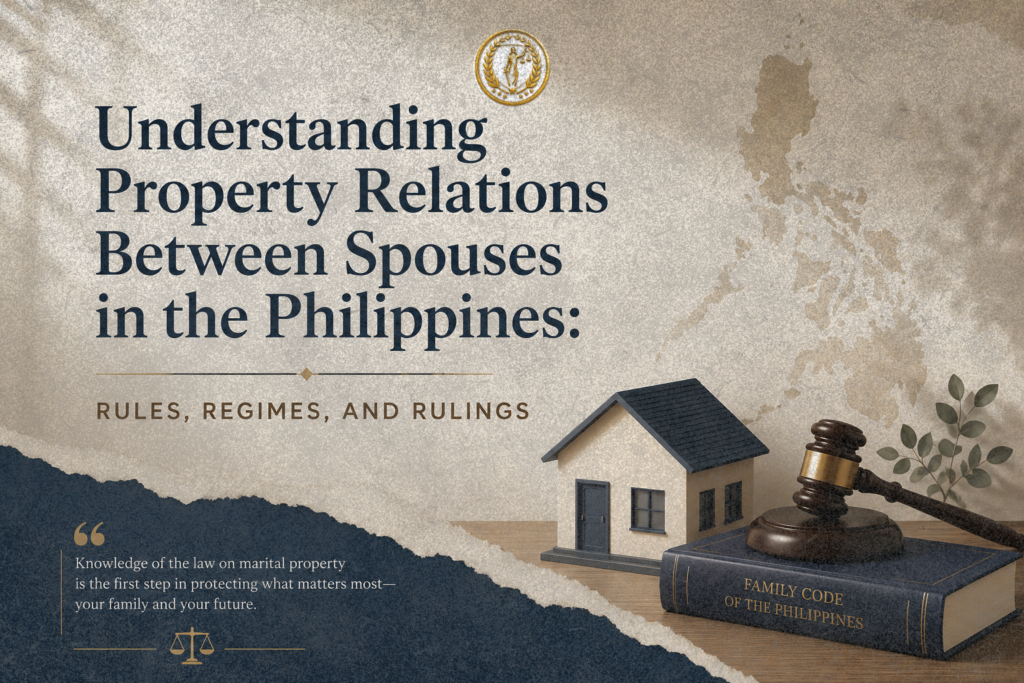
Imagine a scenario where a married couple buys a parcel of land in the Philippines. Years later, due to a personal disagreement, the husband decides to sell the entire property to an unsuspecting buyer without telling his wife. The wife discovers the transaction and demands the return of the land. This situation happens frequently across the country, causing intense family disputes and complex legal battles over property relations between spouses in the Philippines.
Property ownership within marriage impacts daily life, business transactions, and financial stability. Knowing who owns what, when a spouse needs consent to sell an asset, and how the law protects family stability can prevent costly litigation. This guide breaks down the essential legal frameworks governing marital assets under Philippine law.
The Legal Doctrine of Marital Property Regimes
The law does not treat all marriages the same way regarding money and land. The date of the marriage determines the default property relationship between a husband and a wife.
The Modern Default: Absolute Community of Property
The Family Code of the Philippines (Executive Order No. 209, 1987) serves as the primary law on property relations today. It applies to couples who married on or after August 3, 1988. For these couples, the law applies the system of Absolute Community of Property as the default regime. This rule activates if they did not sign a prenuptial agreement before the wedding.
Under this system, the husband and wife become co-owners of all properties. This includes assets they brought into the marriage. It also includes everything they acquire during the union
The Old Default: Conjugal Partnership of Gains
Conversely, the Civil Code of the Philippines (Republic Act No. 386, 1949) governs older marriages. For couples who married before August 3, 1988, the default system is different. They follow the Conjugal Partnership of Gains.
Under this older regime, each spouse retains ownership of their separate properties. These are assets brought into the marriage or inherited. However, the fruits and net gains of those properties during the marriage form a common fund. The couple shares this common fund equally upon dissolution of the marriage.
Key Supreme Court Rulings on Marital Assets
The Philippine Supreme Court strictly enforces these property boundaries. This enforcement protects both spouses and innocent third parties.
In the landmark en banc case of Belinda Alexander vs. Spouses Jorge and Hilaria Escalona, and Reygan Escalona (G.R. No. 256141, July 19, 2022), the Supreme Court clarified a critical rule. They detailed the severe consequences when one spouse sells common property without the written consent of the other.
The Court emphasized that the law treats such a sale as completely void. It is not merely voidable. One spouse simply lacks the unilateral authority to dispose of common assets.
Furthermore, the foundational structure of these property regimes rests entirely on a valid marital bond. In the case of Jesus Nicardo M. Falcis, III vs. Civil Registrar General (G.R. No. 217910, September 03, 2019), the Supreme Court highlighted the institutional nature of marriage. They reinforced that the legal definitions of marriage directly dictate how the state recognizes property relations.
Key Elements and Requisites of Marital Property Management
To determine how spouses must manage or sell their assets, courts look at specific requisites. The Family Code and the Civil Code establish these clear conditions.
Requisites for a Valid Property Sale During Marriage
When a couple wishes to sell real estate or valuable assets belonging to their marriage today, they must satisfy the following conditions:
- Proof of Ownership Regime: The asset must fall clearly within either the Absolute Community or the Conjugal Partnership of Gains.
- Written Mutual Consent: Both the husband and the wife must sign the deed of sale, or one spouse must obtain a written authorization from the other.
- Court Authority: If one spouse cannot give consent due to incapacity or abandonment, the managing spouse must obtain judicial authorization before executing the sale.
Determining the Applicable Property Regime
To identify which rules govern a disputed asset, check these key factors:
- The Date of Marriage Celebration: Marriages before August 3, 1988, follow the Civil Code rules, while subsequent marriages follow the Family Code.
- The Presence of a Marriage Settlement: The terms of a valid, written prenuptial agreement executed before the wedding ceremony override the default legal regimes.
- The Manner of Acquisition: The law traces whether a spouse acquired an asset through lucrative title like an inheritance or onerous title like a purchase using salary
Common Misconceptions About Marital Property
Myth 1: Single Names on Titles
The Myth: “Since my name is the only one listed on the Transfer Certificate of Title, I can sell the land by myself.”
This is a dangerous and widespread error. Even if a land title reflects only one spouse’s name, the law creates a strong presumption. Philippine law presumes the property belongs to the marriage if the couple acquired it during their marital union.
The phrase “married to” on a title serves as a description of civil status. It is not a declaration of exclusive ownership. A unilateral sale will fail under the doctrine laid out in Alexander vs. Escalona.
Myth 2: Automatic Rights After Abandonment
The Myth: “A spouse can automatically sell common property if the other spouse abandons the family.”
Abandonment does not give the remaining spouse an automatic right to sell conjugal or community land. The managing spouse must still file a formal petition in court. They must seek judicial authority for the sale before signing any papers. Without a court order or the missing spouse’s signature, the transaction remains void under the Family Code.
Summary of the Main Takeaways
Philippine law creates structured boundaries for managing wealth within a marriage. The Family Code sets Absolute Community as the modern default. This system makes both spouses equal co-owners of almost everything. The Civil Code maintains Conjugal Partnership of Gains for older marriages.
As the Supreme Court affirmed in Alexander vs. Escalona, neither spouse can sell or donate common real estate without the explicit, written consent of the other. Transactions that violate this rule face total invalidation under the law. This standard protects the family home and common investments from unilateral decisions.
Call to Action
Property disputes within a marriage involve intricate legal rules, prescriptive periods, and evidence gathering. For proper guidance on marital property regimes, asset protection, or real estate transactions, it is best to consult with a qualified legal professional.
Explore more educational guides regarding family law and property management by visiting our resource library at Tamayao Law Office Articles.

Leave a Reply