
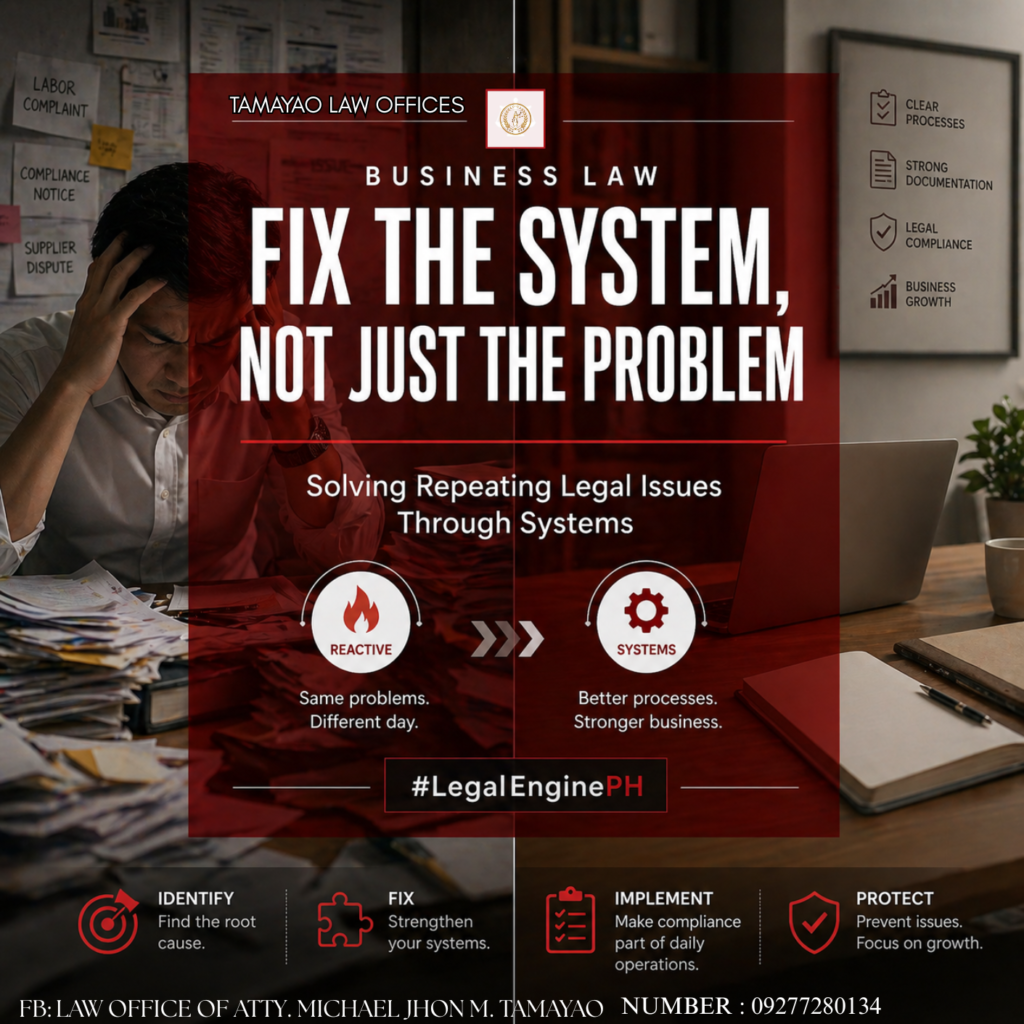
In many Philippine boardrooms and management offices, a frustrating phenomenon occurs: the same legal problems keep coming back. Whether it is a recurring dispute over overtime pay, consistent friction with suppliers, or repeated notices from regulatory bodies, these issues often feel like an unavoidable tax on doing bus iness.
Traditionally, most entrepreneurs handle these problems using a “firefighting” style. When a legal spark appears, they call their lawyer to douse the flames. While this reactive approach might save the building today, it does nothing to prevent the fire from starting again tomorrow. Consequently, the business owner remains trapped in a cycle of crisis management, draining both their time and their resources.
The good news is that there is a more efficient way. By moving away from reactive lawyering and adopting a systems approach, you can build a “Legal Engine” that solves these repeating problems permanently.
The Problem with the “Firefighting” Method
The firefighting style is fundamentally flawed because it treats the symptom rather than the disease. In the Philippines, where the cost of litigation and administrative hearings is high, being reactive is a massive financial burden.
When a business is reactive, legal costs are unpredictable. Furthermore, the “solution” is often temporary—a settlement here, a revised memo there. However, because the underlying process remains unchanged, the same error is eventually repeated by a different manager or in a different department. This cycle exists because most businesses view legal matters as external events rather than internal operational failures.
The Systems Approach: Integrating a Legal Engine
A systems approach recognizes that a business is a web of interconnected processes. In this framework, a legal problem is rarely an isolated incident. Instead, it is usually the result of a “crack” in the system. To fix these repeating issues, one must integrate a Legal Engine into the business’s DNA.
A Legal Engine is a systematized infrastructure that ensures legal safeguards are embedded in every operational step. Transitioning to this model requires a clear, three-step process:
1. The Operational Audit
The process begins by auditing existing processes. We don’t just look at files; we look at how work actually flows. Where do contracts get signed? Who handles the data? How are disciplinary actions initiated? This audit identifies the “Risk Nodes” where the repeating problems are born.
2. Fixing the Process
Once the audit reveals the cracks, the next step is to fix the process. If labor complaints are recurring, we don’t just rewrite one contract; we re-engineer the entire hiring and offboarding workflow. This ensures that the lawful path becomes the path of least resistance for your managers.
3. Devising an Accessible Guide
A system is only useful if it is used. The final step is creating an easy-to-access guide or digital map. Instead of a dusty 300-page manual, the Legal Engine provides a “clickable” interface—like a Whimsical map—where a manager can instantly access the vetted forms, checklists, and guidelines they need for any given situation.
How Systems Interconnect: The Domino Effect
To understand why a legal engine is necessary, one must see how systems naturally affect all aspects of a business. A single complaint from an employee is rarely just about a “bad attitude.” Often, it is rooted in interconnected issues within the system.
Consider this common scenario:
- The Root Cause: A business uses a generic, non-compliant contract found online.
- The Friction: Because the contract is vague, the employer and employee fail to see the true scope of work and the specific rights and obligations of each party.
- The Conflict: Disagreements arise over duties and compensation.
- The Result: The business terminates the employee without following the strict procedural due process required by Philippine law, leading to a costly illegal dismissal case.
In this example, the “fire” is the illegal dismissal case. However, the “fuel” was the non-compliant contract and the lack of a clear system. If the business had a Legal Engine in place, the manager would have had access to a vetted, BPO-specific contract from day one, preventing the confusion entirely.
The Good News: Drafting Without the Delay
The most common reason business owners skip legal reviews is the “Lawyer Bottleneck.” Owners dislike calling a lawyer and waiting days for a draft when they need to hire someone now.
The Legal Engine solves this. By building a system that incorporates pre-vetted, automated forms, your team can generate a compliant contract or a “Notice to Explain” in minutes. You no longer have to call and wait for a lawyer for routine tasks because the “Lawyer’s Intelligence” is already built into your system.
This accessibility empowers your management team. It allows the business to move at full speed while remaining under the protection of a permanent legal shield.
Conclusion: Engineering Your Way to Peace of Mind
Solving repeating legal problems requires a shift in mindset. You must stop seeing yourself as a firefighter and start seeing yourself as an engineer. By auditing your processes and installing a robust Legal Engine, you ensure that the mistakes of the past stay in the past.
A systems approach doesn’t just save you from lawsuits; it saves your Time and Energy. It allows you to concentrate on the growth of your vision while the engine handles the protection. In the Philippine business environment, the law favors the smart and the prepared. Building a system is the smartest move you can make.
Take Control of Your System
Repeating problems are a signal that your system needs an upgrade. If you are tired of dousing the same legal fires, it is time to look at the blueprint of your operations. To learn more about how systems can protect your business and improve efficiency, feel free to explore our insights in our articles category.
For owners ready to integrate a Legal Engine into their enterprise, consulting with a strategic professional can provide the audit and the architecture needed for a permanent solution.



Leave a Reply