

Rico built his furniture business in Tuguegarao with one goal in mind: to create heirloom-quality pieces for Filipino families. However, as his business expanded, new problems emerged. He needed more workers, suppliers, and systems. Soon, Rico spent more time asking, “How do I handle labor concerns?” and “How do I draft contracts?” than actually growing his business.
This situation reflects what many entrepreneurs experience today. Business owners often try to solve every operational and legal problem by themselves. Yet, in the Philippines, labor compliance involves complex obligations under the Labor Code and DOLE regulations. One mistake involving contractors or outsourced workers may expose a business to significant liability.
Many companies hire contractors to save time and reduce operational burdens. However, improper contracting arrangements may lead to findings of labor-only contracting. When that happens, the principal company may become the direct employer of the workers and may face liability for unpaid wages and labor violations.
For this reason, understanding contractor liability is not just a legal issue. It is a business survival issue.
Understanding Contractor Liability Under Philippine Law
The Labor Code of the Philippines allows legitimate contracting and subcontracting arrangements. However, it strictly prohibits labor-only contracting.
Under the Labor Code, principals may become jointly and severally liable with contractors for unpaid wages and labor-related obligations. Moreover, if authorities determine that labor-only contracting exists, the contractor becomes merely an agent of the principal employer.
As a result, the principal may be treated as the direct employer of the workers.
DOLE Department Order No. 174-17 reinforces this principle. It states that even in lawful contracting arrangements, principals may still face solidary liability for violations of labor laws and social legislation.
The Supreme Court has consistently emphasized the importance of protecting workers from arrangements that circumvent labor rights.
In Manggagawa sa Komunikasyon ng Pilipinas v. PLDT, Inc. (G.R. Nos. 244695, 244752 & 245294, February 14, 2024), the Court examined contracting arrangements and labor rights involving workers who performed functions related to the principal’s business.
Similarly, in Martinez, et al. v. San Miguel Foods, Inc. (G.R. No. 231579), the Supreme Court reinforced the importance of examining the true nature of the employment relationship rather than relying solely on contractual labels.
These rulings remind businesses that courts examine actual business practices, degree of control, and the contractor’s independence.
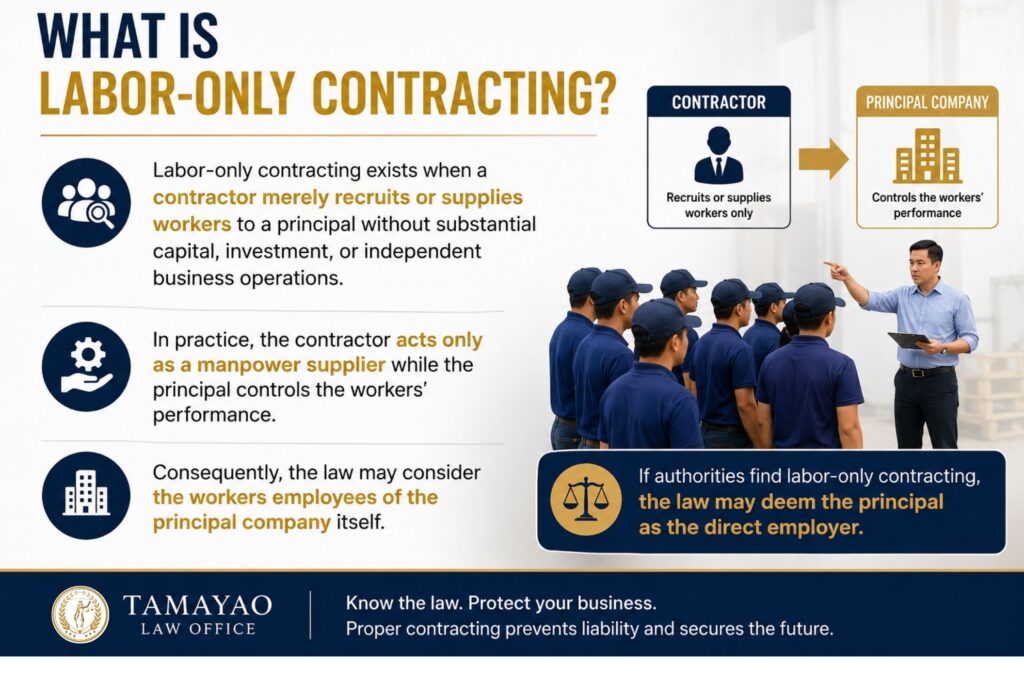
What Is Labor-Only Contracting?
Labor-only contracting exists when a contractor merely recruits or supplies workers to a principal without substantial capital, investment, or independent business operations.
In practice, the contractor acts only as a manpower supplier while the principal controls the workers’ performance.
Consequently, the law may consider the workers employees of the principal company itself.
Key Indicators of Labor-Only Contracting
Philippine law and DOLE regulations commonly examine the following factors:
- The contractor lacks substantial capital or investment.
- The contractor does not own tools, equipment, or work premises.
- The workers perform activities directly related to the principal’s main business.
- The principal exercises control over the workers’ performance.
- The contractor merely recruits or supplies manpower.
- The contractor does not independently manage operations.
When these indicators appear together, authorities may classify the arrangement as labor-only contracting.
Common Misconceptions About Contracting Arrangements
Myth #1: “A written contract automatically protects the principal.”
Not necessarily.
Courts examine the actual relationship between the parties. Even if documents describe the contractor as “independent,” authorities may still find labor-only contracting if business practices show otherwise.
Therefore, compliance requires more than paperwork.
Myth #2: “Outsourced workers are never the principal’s responsibility.”
This misconception often creates serious legal exposure.
Under the Labor Code and DOLE regulations, principals may still become solidarily liable for labor violations, even in permissible contracting arrangements.
Accordingly, businesses should regularly monitor the compliance practices of contractors and subcontractors.
The Real Business Lesson: Stop Being the “How”
Many entrepreneurs fall into the “How” Trap. They attempt to personally solve labor, compliance, and operational problems despite limited expertise and time.
However, sustainable businesses grow through proper delegation.
Instead of asking:
- “How do I solve this labor issue myself?”
Effective business leaders ask:
- “Who can help build compliant systems for the business?”
That shift protects both time and long-term business stability. More importantly, it allows entrepreneurs to focus on strategy, innovation, and growth instead of constantly reacting to legal risks.
In a regulated environment like the Philippines, proactive compliance strengthens business sustainability.
Conclusion
Growth creates opportunity, but it also creates responsibility.
As businesses expand, contractor relationships often become necessary. However, improper contracting arrangements may expose principals to serious liabilities under Philippine labor law.
The Supreme Court rulings in Manggagawa sa Komunikasyon ng Pilipinas v. PLDT, Inc. and Martinez, et al. v. San Miguel Foods, Inc. show that courts carefully examine the true nature of employment relationships.
Ultimately, compliance requires more than contracts. It requires proper systems, responsible management, and informed decision-making.
For more educational legal insights, visit the articles section of Tamayao Law Office: https://tamayaolawoffice.com/category/articles/



Leave a Reply