
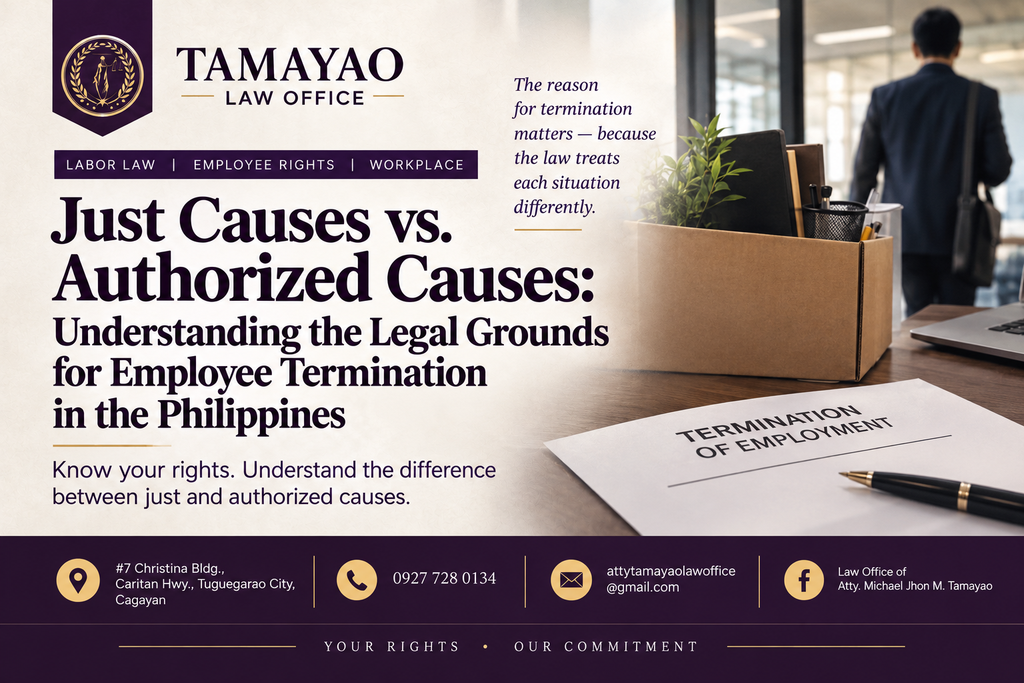
Introduction: Can an Employer Legally Terminate an Employee?
Imagine receiving a termination letter after several years of working for a company. Your employer explains that the company no longer needs your position. In another situation, an employee loses their job because management accuses them of dishonesty or repeatedly neglecting their responsibilities.
Although both situations result in the loss of employment, Philippine labor law treats them differently.
The distinction lies between just causes and authorized causes of termination. One involves an employee’s wrongful conduct, while the other arises from legitimate business circumstances or certain health conditions.
This distinction matters because the law imposes different requirements for each type of termination. It also determines the applicable notice requirements, the employee’s entitlement to separation pay, and the employer’s obligations under the Labor Code.
Understanding these differences helps employees recognize their rights and helps employers comply with lawful termination procedures.
The Legal Doctrine: What Is the Difference Between Just and Authorized Causes?
The Philippine Labor Code recognizes two principal categories of termination: just causes under Article 297 (formerly Article 282) and authorized causes under Articles 298 and 299 (formerly Articles 283 and 284).
1. Just Causes: When the Employee’s Conduct Justifies Termination
Just causes arise from an employee’s serious misconduct, negligence, dishonesty, or other legally recognized wrongful conduct.
Under Article 297 of the Labor Code, an employer may terminate employment for the following reasons:
- Serious misconduct or willful disobedience: The employee commits serious misconduct or deliberately refuses to follow lawful and work-related instructions.
- Gross and habitual neglect of duties: The employee repeatedly and seriously neglects responsibilities.
- Fraud or willful breach of trust: The employee commits fraud or deliberately violates the trust that the employer places in them.
- Commission of a crime or offense: The employee commits an offense against the employer, an immediate member of the employer’s family, or the employer’s duly authorized representative.
- Other analogous causes: The employee commits another voluntary or willful act similar in nature to the grounds expressly identified in the law and properly identified in company rules or policies.
However, an employer cannot simply accuse an employee of wrongdoing and immediately terminate employment.
In Tiu v. National Labor Relations Commission (G.R. No. 83433, November 12, 1992), the Supreme Court recognized that an employer cannot establish loss of trust and confidence through suspicion or conjecture alone. A dismissal on this ground requires a willful breach of trust supported by substantial evidence.
This principle protects employees against arbitrary termination. In other words, an employer must present evidence that reasonably establishes the employee’s wrongful conduct.
Read the full decision: Tiu v. NLRC (1992).
2. Authorized Causes: When Business Circumstances Require Termination
Unlike just causes, authorized causes do not necessarily involve employee wrongdoing.
Instead, they arise from legitimate business necessities, changing economic conditions, or certain illnesses that meet the requirements of the law.
Articles 298 and 299 of the Labor Code recognize the following grounds:
- Installation of labor-saving devices: The employer introduces technology or equipment that reduces the need for certain positions.
- Redundancy: The employer determines that a position has become unnecessary.
- Retrenchment to prevent losses: The employer reduces its workforce to prevent serious business losses.
- Closure or cessation of business: The employer permanently or partially closes business operations.
- Disease or illness: The employee suffers from a disease that meets the applicable statutory requirements for termination.
In Bacani v. Fiber Textile Manufacturing Corp. (G.R. No. 271518, September 30, 2025), the Supreme Court discussed the distinction between just and authorized causes. The decision recognizes that authorized-cause termination involves legitimate management prerogatives, such as retrenchment, closure, or the installation of labor-saving devices.
Consequently, an employee who loses a position because of legitimate business restructuring does not automatically commit an employment violation.
Read the full decision: Bacani v. Fiber Textile Manufacturing Corp. (2025).
Key Requirements: What Must an Employer Establish?
An employer must establish a valid legal ground and follow the applicable procedural requirements before terminating employment.
A. Requirements for Just-Cause Termination
The employer must:
- Establish a legally recognized just cause under Article 297.
- Support the allegations with substantial evidence.
- Issue a first written notice explaining the specific acts or omissions charged.
- Give the employee a reasonable opportunity to explain and defend themselves, generally allowing at least five calendar days.
- Issue a second written notice communicating the employer’s decision after considering the employee’s explanation and the evidence.
This procedure follows the two-notice rule under DOLE Department Order No. 147-15.
B. Requirements for Authorized-Cause Termination
For authorized causes, the employer must:
- Establish a legitimate ground under Articles 298 or 299.
- Support the ground with the evidence and requirements applicable to that particular cause.
- Give written notice to the employee at least 30 days before the termination takes effect.
- Submit the required written notice to the appropriate DOLE Regional Office within the same period.
- Pay the applicable separation pay when the law requires it.
Unlike just-cause termination, authorized-cause termination does not generally require a hearing to determine employee culpability because the employer does not base the decision on employee misconduct.
Common Misconceptions About Employee Termination
Myth No. 1: An employer can dismiss an employee simply because management has lost trust in them.
Not necessarily. In Tiu v. NLRC, the Supreme Court emphasized that loss of trust and confidence requires a willful breach supported by substantial evidence. Mere suspicion does not establish a valid ground for dismissal.
Myth No. 2: Every terminated employee automatically receives separation pay.
This is incorrect. Employees dismissed for just causes generally do not receive statutory separation pay unless a contract, collective bargaining agreement, or established company policy or practice provides otherwise.
However, authorized-cause termination generally carries a separation pay obligation, subject to the specific statutory rules and exceptions.
Conclusion: The Reason for Termination Determines the Legal Requirements
The distinction between just and authorized causes goes beyond the reason an employer gives for ending employment. It determines the legal standards, procedural obligations, and financial consequences of termination.
For just causes, employers must establish employee misconduct or another legally recognized ground through substantial evidence and observe the required due process.
For authorized causes, employers must demonstrate legitimate business or health-related grounds, comply with the applicable notice requirements, and provide separation pay when required by law.
Ultimately, Philippine labor law protects an employee’s security of tenure while recognizing an employer’s legitimate right to manage business operations.
For more educational discussions on employment rights, workplace obligations, and Philippine labor law, readers may visit the Tamayao Law Office Articles Page.
Call to Action
Whether an employee faces termination or an employer needs to understand its obligations, proper knowledge of Philippine labor law remains essential. For specific concerns involving employee dismissal, separation pay, or workplace compliance, it is best to consult with a qualified legal professional.

Leave a Reply