
Imagine discovering in adulthood that your official birth certificate does not carry the surname you have used your entire life. You grew up using your father’s surname on school records, government identification cards, and employment documents. However, when you request a copy of your civil registry record, you find that your mother used her maiden surname and left the father’s section blank.
Across the Philippines, many individuals face this exact administrative dilemma. Marital discord at the time of a child’s birth often leads one parent to omit the other’s details during civil registration. Consequently, affected individuals encounter serious legal hurdles when applying for passports, professional licenses, or inheritance claims.
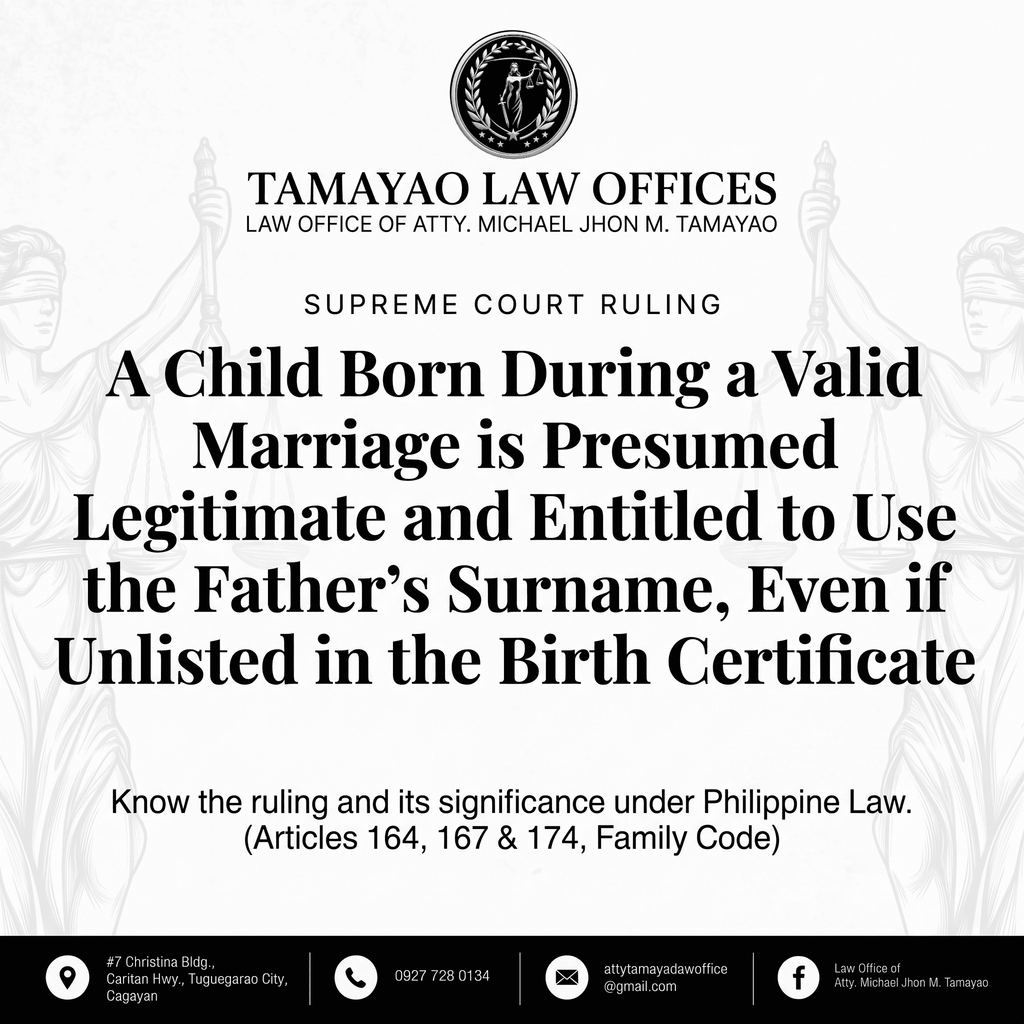
Fortunately, the Supreme Court of the Philippines clarified how Philippine family law resolves this discrepancy. In a Decision penned by Associate Justice Japar B. Dimaampao (Third Division), the High Court affirmed that a child born during a valid marriage enjoys the legal presumption of legitimacy and holds the right to bear the father’s surname—even if the birth certificate omits the father’s identity.
The Legal Doctrine: Presumption of Legitimacy Under the Family Code
Philippine law strongly favors the legitimacy of children born within a valid marriage. Under Article 164 of the Family Code, children conceived or born during the marriage of the parents are legitimate.
In the ruling reviewed by the Supreme Court’s Third Division (read the Supreme Court PIO Press Release and the Full Decision), the petitioner was born in 1996, two years after her parents validly married in 1994. Because the spouses were estranged at that time, her mother registered the birth using her own maiden surname, listed her own middle name as the child’s middle name, and omitted the father’s name entirely. Despite these entries, the petitioner consistently used her father’s surname throughout her education and career, including on her Professional Regulation Commission (PRC) identification card.
When she discovered the discrepancies in 2017, she filed a petition to correct her birth certificate. Both the Regional Trial Court and the Court of Appeals initially dismissed her petition, reasoning that her parents’ marriage certificate alone did not prove paternity petition, reasoning that her parents’ marriage certificate alone did not prove paternity.
However, the Supreme Court reversed the lower courts and ruled in her favor. Associate Justice Dimaampao explained that the law automatically presumes a child born during a valid marriage to be the legitimate child of the spouses. Therefore, the child does not bear the burden of proving filiation to the father. Instead, only the husband holds the legal standing to challenge the child’s legitimacy, and he must file a direct action within the strict period prescribed by law. Since the husband never filed such an action, the petitioner’s legitimate status remained intact.
Key Requirements for Correcting Civil Registry Entries Under Rule 108
Correcting substantial entries in a birth certificate—such as changing a surname, middle name, and parental details—requires strict adherence to procedural rules. Under Rule 108 of the Rules of Court, a petitioner must fulfill several mandatory conditions to obtain a valid judicial correction:
- File an Adversarial Proceeding: The petitioner must initiate a formal petition before the proper Regional Trial Court rather than relying on simple administrative correction procedures.
- Implead All Interested Parties: The petition must name the Local Civil Registrar and all persons who have or claim any interest that the proposed correction would affect.
- Comply with Publication and Notice Rules: The court must publish the notice of hearing in a newspaper of general circulation and serve notices to the concerned government offices, including the Office of the Solicitor General.
- Prove Valid Marriage at the Time of Birth: The petitioner must establish that their parents were legally married when the child was conceived or born, triggering the presumption under Article 164 of the Family Code.
- Demonstrate Absence of Impugnation: The records must show that the husband never successfully impugned the child’s legitimacy within the prescriptive period set by law.
Common Misconceptions About Birth Certificates and Legitimacy
Misunderstandings regarding civil registry documents frequently prevent Filipinos from asserting their statutory rights. Clarifying these myths helps families navigate civil status issues accurately.
Myth 1: A Blank Father’s Section Automatically Makes a Child Illegitimate
Many people assume that if a father does not sign a birth certificate or if his name does not appear on the document, the child automatically becomes illegitimate. Fact: Legitimacy is determined by the marital status of the parents at the time of the child’s conception or birth, not by the entries typed onto a civil registry form. Under Article 167 of the Family Code, a mother’s unilateral declaration or omission cannot strip a child of legitimacy.
Myth 2: Correcting a Birth Certificate Creates Legitimacy
Some individuals fear that filing a Rule 108 petition asks the court to confer a new legal status upon the child. Fact: As the Supreme Court explicitly stated in this ruling, granting substantial corrections to reflect the father’s surname and the parents’ marriage details does not create legitimacy. Rather, the judicial correction merely aligns the public civil registry with a legitimate status that already exists by operation of law.
Conclusion
A birth certificate serves as prima facie evidence of the facts stated within it, yet it never overrides the clear mandates of the Family Code. Between an erroneous birth record and the statutory presumption of legitimacy, Philippine law prioritizes the presumption of legitimacy in accordance with public policy and the best interests of the child. Consequently, individuals born during a valid marriage can judicially align their official records with their true legal identity and bear their father’s surname.
For more accessible guides on Philippine jurisprudence and family law updates, explore our collection of legal articles at the Tamayao Law Office Articles Archive.
Need Guidance on Civil Registry or Family Law Matters?
Navigating petitions for the correction of entries under Rule 108 requires careful review of your civil registry documents and supporting evidence. If you or your family encounter discrepancies in your birth records, consulting a qualified legal professional can help you understand the proper procedural remedies available under Philippine law.

Leave a Reply