
Introduction
Imagine a person whose religious beliefs require a particular practice that conflicts with a government rule. The State may have a legitimate reason for enforcing that rule. However, does that automatically mean the government can restrict the person’s religious practice?
Not necessarily.
Religious freedom occupies a special place in constitutional law. The State may pursue legitimate objectives, but it cannot simply override religious liberty whenever a government interest exists. When a person’s religious exercise conflicts with a government regulation, the State must meet a demanding constitutional standard.
The Supreme Court addressed this difficult balance in Estrada v. Escritor, A.M. No. P-02-1651, August 4, 2003. The case provides an important framework for understanding when the State may limit religious freedom and what the government must demonstrate before doing so.
The Legal Doctrine: Religious Freedom and the Compelling State Interest Test
In Estrada v. Escritor, the Supreme Court recognized that religious liberty and the State’s interests can sometimes come into conflict.
The Court adopted the benevolent neutrality approach in interpreting cases involving religious freedom. Under this approach, the government should not act with hostility toward religious beliefs or simply disregard a claim of religious exercise because a person’s conduct conflicts with a generally applicable rule.
However, religious freedom does not mean that every religious claim automatically prevails.
Instead, when government action burdens religious exercise, the Court applies the compelling state interest test, particularly when the claim involves conduct arising from religious belief.
The test places a heavy burden on the State.
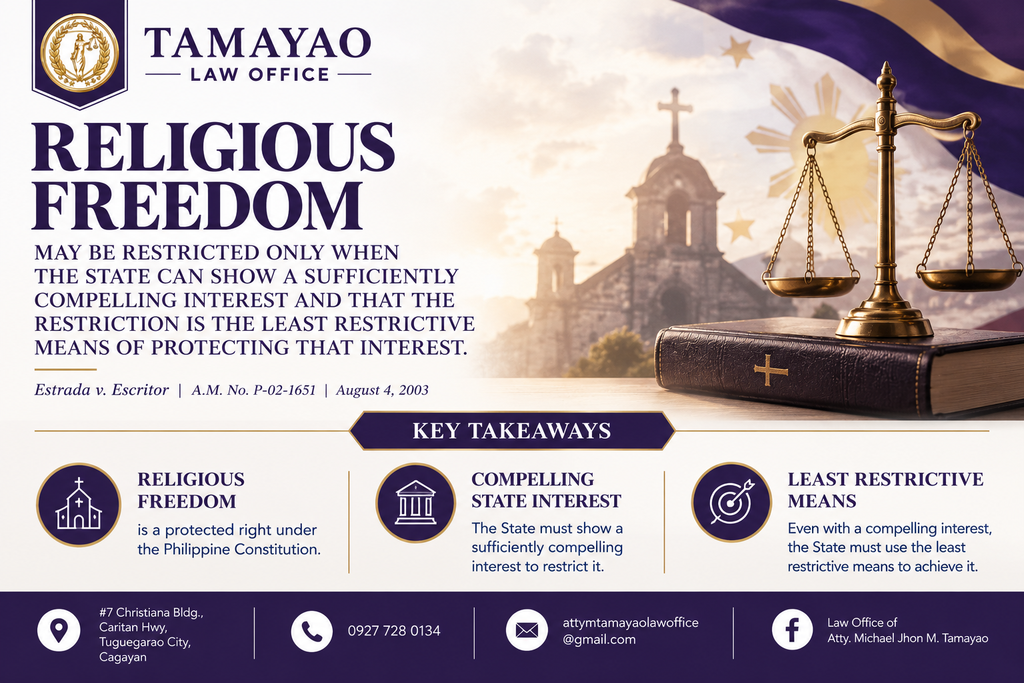
First, the State must establish that it has a sufficiently compelling interest that justifies limiting religious liberty. A government agency cannot merely identify a legitimate objective and assume that the objective automatically outweighs religious freedom.
The government must show precisely how the religious exemption would undermine the State’s interest and why that interest deserves greater protection under the circumstances.
Second, even when the State establishes a compelling interest, it must use the least restrictive means of achieving that objective.
In other words, the government must demonstrate that it selected a method that protects its legitimate objective while imposing as little restriction as possible on the person’s religious exercise.
The Supreme Court emphasized that not every government interest can overcome religious freedom. Religious liberty enjoys a preferred position because it involves a fundamental right.
Consequently, the State carries a heavy burden when it seeks to restrict religious exercise.
What Must the State Establish?
Under the framework discussed in Estrada v. Escritor, the analysis involves several important considerations:
- A religious belief or practice must be involved. The protection concerns religious exercise rather than merely secular beliefs or personal preferences.
- The sincerity and centrality of the claimed religious belief matter. The Court recognized the importance of examining whether the person’s claimed belief genuinely forms part of the person’s religious exercise.
- The State must identify a compelling interest. The government must establish more than a general or merely colorable interest. It must explain why the interest deserves to prevail over the individual’s religious liberty.
- The State must demonstrate the actual impact of the religious exemption. The government must show how allowing the religious practice or exemption would undermine its objective.
- The State must use the least restrictive means. Even if the State possesses a compelling interest, it must pursue that interest through a method that restricts religious exercise no more than necessary.
These requirements prevent the government from treating religious freedom as an ordinary interest that it can simply balance against any government objective.
Why the Least Restrictive Means Requirement Matters
The least-restrictive-means requirement provides an additional safeguard for religious liberty.
Suppose the State has a legitimate and compelling objective. That alone does not end the constitutional inquiry. The government must still consider whether it can accomplish its objective through a less intrusive method.
The question therefore becomes: Can the State protect its compelling interest without placing such a substantial burden on the person’s religious exercise?
If a less restrictive alternative can accomplish the same legitimate objective, the State cannot simply choose the method that places the greatest burden on religious freedom.
This approach reflects the Court’s recognition that religious liberty requires meaningful protection, particularly when the government seeks to regulate conduct based on religious belief.
Common Misconceptions
Myth: The government can restrict religious practices whenever it has a legitimate reason.
Not necessarily. Estrada v. Escritor requires more than an ordinary legitimate government interest when the State seeks to override protected religious exercise. The State must demonstrate a sufficiently compelling interest.
Myth: Once the State proves a compelling interest, religious freedom automatically loses.
Not quite. The State must also show that it uses the least restrictive means to accomplish its objective. The government must therefore satisfy both the compelling-interest requirement and the least-restrictive-means requirement.
Conclusion
Religious freedom does not operate without constitutional limits. At the same time, the State cannot restrict religious exercise simply because a government rule or objective conflicts with a person’s religious practice.
Estrada v. Escritor demonstrates the careful balance required when religious liberty and government interests collide.
The State must carry a heavy burden. It must establish a sufficiently compelling interest and demonstrate that it has chosen the least restrictive means of protecting that interest.
Ultimately, the doctrine seeks to protect both constitutional government and religious liberty by ensuring that restrictions on religious exercise receive careful and demanding scrutiny.
Need Guidance on a Religious-Freedom Concern?
Questions involving religious practices and government regulations can depend heavily on the particular facts and circumstances. For specific concerns, it is best to consult a qualified legal professional who can assess the applicable law and circumstances.
For more Philippine legal information, readers may explore the Articles section of Tamayao Law Office.



Leave a Reply