
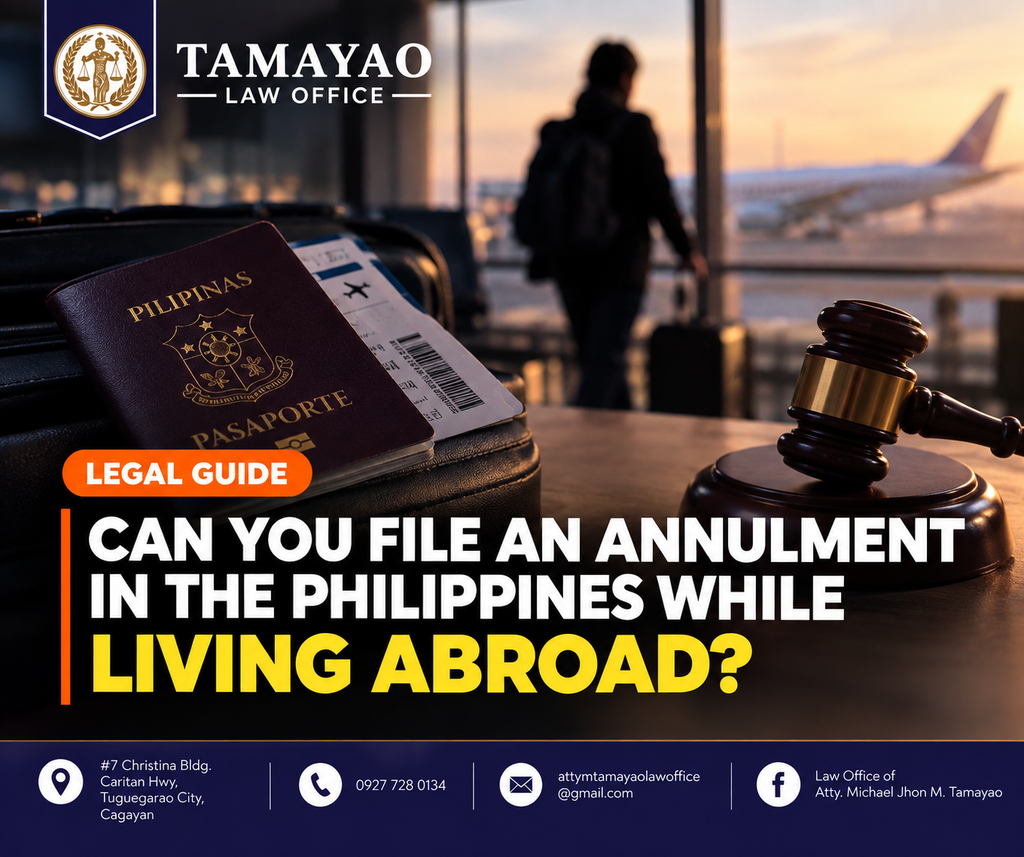
Introduction: Living Abroad Does Not Automatically Prevent a Philippine Petition
Many Filipinos live or work abroad for employment, business, or other reasons. Some may eventually face questions about their marital status and wonder: Can a petition for annulment or declaration of nullity still be filed in the Philippines even if one or both spouses live overseas?
Generally, Philippine law allows a Filipino spouse to pursue a petition for annulment of a voidable marriage or declaration of absolute nullity of a void marriage while living abroad. However, the petitioner must still comply with the applicable jurisdiction and venue requirements.
The issue becomes particularly important when the marriage took place abroad, when one spouse is a foreign national, or when both spouses currently live outside the Philippines.
The Legal Doctrine: Where Can the Petition Be Filed?
The Supreme Court addressed this issue in Gianni De Munari v. Thelma Gagui Asprec, et al., G.R. No. 262831, April 7, 2025.
In De Munari v. Asprec, the Court held that Philippine courts have jurisdiction over a petition seeking to declare void a bigamous marriage celebrated abroad between a foreigner and a Filipino. The Court also recognized that a foreign spouse may file a petition for declaration of absolute nullity because the applicable rule allows either the husband or the wife to file.
The Rule on Declaration of Absolute Nullity of Void Marriages and Annulment of Voidable Marriages provides that a petition for declaration of absolute nullity may be filed solely by the husband or the wife. Importantly, the rule does not distinguish between Filipino and foreign spouses.
Therefore, nationality alone does not prevent a foreign spouse from filing a petition involving a Filipino spouse.
At the same time, filing the case requires more than simply establishing that a marriage exists. The petitioner must also comply with the applicable venue and residency requirements.
Where Should a Person Living Abroad File?
The 2023 amendments to A.M. No. 02-11-10-SC provide specific rules concerning venue.
Generally, the petition may be filed in the Family Court of the province or city:
- Where the petitioner or respondent has resided for at least six months immediately before filing; or
- If the respondent is a nonresident, where the respondent may be found in the Philippines, subject to the applicable rule.
The rules also address situations where both spouses live abroad.
If both spouses reside abroad, the petition may be filed:
- At the place of the habitual residence of either party, at the petitioner’s election; or
- At the place where the spouses last resided together as husband and wife in the Philippines.
If only the petitioner resides abroad, the venue is generally the place where the respondent resides in the Philippines.
These rules make accurate allegations regarding residence particularly important. The source material emphasizes that courts require strict compliance, and insufficient or false allegations concerning residence may result in dismissal and possible sanctions.
Annulment vs. Declaration of Absolute Nullity
The terms “annulment” and “declaration of nullity” often appear together, but they refer to different legal concepts.
| Declaration of Absolute Nullity | Annulment |
|---|
| Concerns a marriage that is void from the beginning | Concerns a voidable marriage that remains valid until annulled |
| Includes grounds such as bigamy and certain prohibited marriages | Includes grounds such as lack of parental consent, fraud, force or intimidation, and certain physical incapacity |
| The action or defense does not prescribe | The applicable ground may have a specific filing period |
Article 39 of the Family Code, as amended by Republic Act No. 8533, provides that an action or defense for declaration of absolute nullity does not prescribe.
However, certain annulment grounds carry specific filing periods. For example, the supplied material states that the five-year period applies to certain grounds involving physical incapacity and serious, apparently incurable sexually transmissible disease.
What If the Marriage Was Celebrated Abroad?
The place where the marriage occurred does not automatically determine whether Philippine courts can hear a case concerning the marriage.
In Rayray v. Lee, G.R. No. L-18176 (1966), the Supreme Court recognized that Philippine courts may annul a marriage celebrated abroad when at least one party is a Filipino citizen or is domiciled in the Philippines. Thus, marital-status jurisdiction does not depend solely on the place of celebration.
Similarly, De Munari v. Asprec demonstrates that Philippine courts may exercise jurisdiction over a petition involving a bigamous marriage celebrated abroad between a Filipino and a foreign national.
What If a Foreign Court Has Already Issued a Judgment?
A different situation arises when a foreign court has already issued a judgment concerning the marriage.
In Fujiki v. Marinay, G.R. No. 196049 (2013), the Supreme Court distinguished a proceeding for an original Philippine declaration of nullity from a proceeding seeking recognition of a foreign judgment.
When recognition of a foreign judgment becomes the objective, the applicable proceeding differs. The foreign judgment and the relevant foreign law must be properly alleged and proven, and the judgment must not violate Philippine public policy.
Can the Parties Attend Hearings Remotely?
Yes, subject to a timely motion and court approval. The 2025 Guidelines on Videoconferencing allow litigants, witnesses, and counsel who are abroad to participate or testify through videoconferencing upon a proper motion filed with the court where the case is pending. The remote appearance must generally take place from an authorized overseas venue, such as a Philippine embassy or consulate, another Philippine government office abroad, or another venue authorized under the Guidelines. See Guidelines on the Conduct of Videoconferencing (2025).
The motion should identify the participant’s location, proposed overseas venue, availability, and the reason remote participation is necessary or appropriate. The hearing remains subject to the court’s control, applicable Philippine procedure, and any restrictions arising from the law of the foreign country.
Must the Parties Personally Appear?
Not necessarily at every hearing. The court may allow a party, witness, or counsel abroad to appear through videoconference. The applicable family-proceeding rules also recognize that, in appropriate circumstances, a duly authorized representative may appear with a special power of attorney, although the court may still require the party’s personal or remote testimony for matters that cannot properly be delegated. See Rule on Family Mediation (2024).
Remote participation should not be confused with a complete waiver of the evidentiary requirements. A declaration of nullity or annulment cannot ordinarily be granted merely on the pleadings, an agreement, or the parties’ failure to attend. The State must be represented through the public prosecutor or Solicitor General, and the case must proceed in accordance with the mandatory procedural safeguards, including pre-trial. See Carlos v. Sandoval (2008) and In Re: Judicial Audit on Branch 64, Regional Trial Court, Guihulngan City (2020).
Practical Answer
If both parties are abroad, the usual procedure is:
- File the petition electronically, if accepted through the authorized court e-filing system.
- File it in the proper Family Court under the 2023 venue rules.
- Submit a motion requesting videoconference appearances or testimony from an authorized overseas venue.
- Wait for the court’s order approving the remote arrangement.
- Ensure that the public prosecutor and, where required, the Solicitor General are properly notified and participate.
- Comply with identity verification, oath-taking, examination, service of pleadings, and other safeguards ordered by the court.
Thus, the case may be initiated and litigated with remote participation, but the parties should not assume that they can simply file online and avoid all court appearances. The Family Court must authorize the remote arrangements, and some testimony or procedural acts may still be required personally or through a court-approved videoconference.
Common Misconceptions
Myth 1: “Living abroad means I cannot file in the Philippines.”
Not necessarily. The supplied legal materials recognize situations where a person living abroad may pursue a Philippine petition. However, the proper venue depends on the circumstances of the spouses’ residence.
Myth 2: “If the marriage happened abroad, only the foreign country can deal with it.”
Not necessarily. Rayray v. Lee and De Munari v. Asprec show that the place of celebration does not, by itself, prevent Philippine courts from exercising jurisdiction over certain marital-status cases.
Myth 3: “If I file online, I never need to attend court.”
Not necessarily. Electronic filing and remote hearings may be available, but they remain subject to court approval and procedural safeguards. The court may still require personal attendance, remote testimony from an authorized venue, or other appearances and submissions.
Key Takeaway
Living or working abroad does not automatically prevent a person from filing a petition for annulment or declaration of absolute nullity in the Philippines.
However, the petitioner must identify the correct remedy and comply with the applicable jurisdiction, venue, and residency requirements. The rules differ depending on whether one or both spouses live abroad, whether the respondent resides in the Philippines, and whether a foreign judgment already exists.
The Supreme Court’s decision in De Munari v. Asprec highlights an important principle: Philippine courts may exercise jurisdiction over certain marriages celebrated abroad, and a foreign spouse may have standing to file a petition for declaration of absolute nullity.
For more educational discussions on Philippine family law and other legal topics, readers may explore the Tamayao Law Office Articles.
For specific concerns involving annulment, declaration of nullity, foreign marriages, foreign judgments, or remote participation in court proceedings, it is best to consult a qualified Philippine legal professional who can evaluate the particular facts and applicable procedural requirements.
Legal Disclaimer
This article is provided for informational and educational purposes only. It does not constitute legal advice and does not create or establish a lawyer-client relationship. Legal outcomes depend on the specific facts and circumstances of each case. For concerns requiring legal advice, consultation with a qualified legal professional is recommended.UndoAccept all

Leave a Reply