
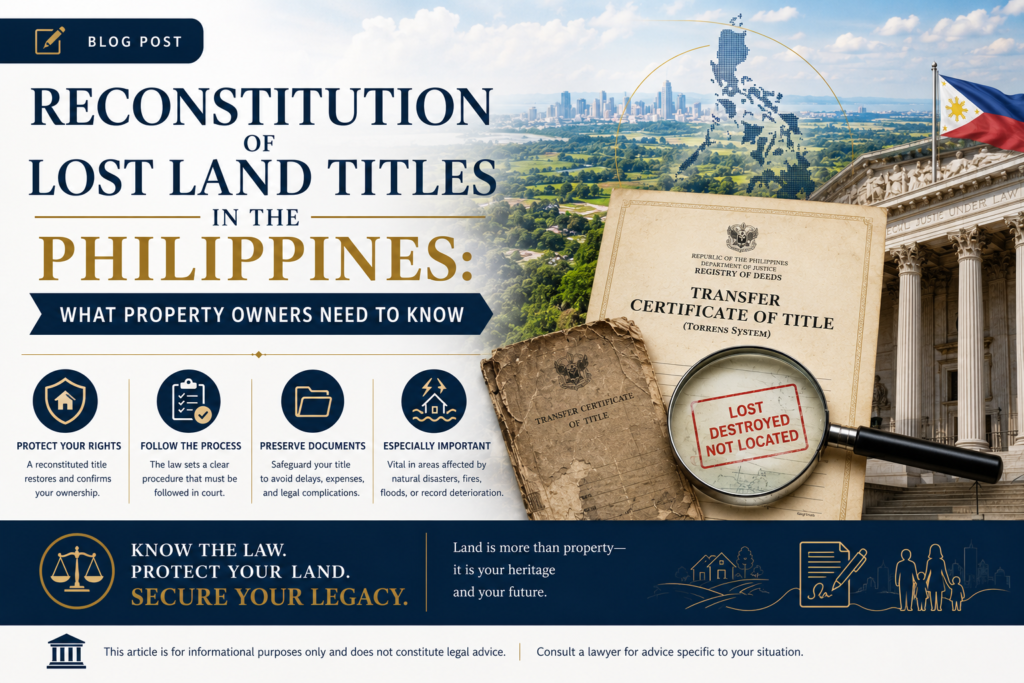
Losing a land title can cause serious concern. Many property owners fear that they may lose their ownership rights if the title can no longer be found. Others believe that a photocopy of the title or a tax declaration will immediately solve the problem.
Fortunately, Philippine law provides a legal remedy. When a Torrens title becomes lost or destroyed, the law allows its reconstitution through a special procedure. This process helps restore the title while protecting the integrity of the land registration system.
Because land remains one of the most valuable assets a person can own, understanding this procedure is important. Property owners should know the basic rules that govern the reconstitution of lost land titles in the Philippines.
Understanding Reconstitution of Land Titles
Reconstitution is the legal process of restoring a lost or destroyed Torrens certificate of title. The goal is to reproduce the original title as it existed before its loss or destruction.
Importantly, reconstitution does not create a new title. It also does not establish ownership for the first time. Instead, it restores an existing title through documents recognized by law.
The governing law is Republic Act No. 26, or the Act Providing a Special Procedure for the Reconstitution of Torrens Certificates of Title Lost or Destroyed. This law sets the requirements, procedures, and documentary sources that courts may use during reconstitution proceedings.
What Did the Supreme Court Say?
The Supreme Court discussed these principles in Republic of the Philippines v. Spouses Jovito and Kathleen Bercede, G.R. No. 214223, dated January 10, 2023.
In that case, the Court emphasized that reconstitution serves a limited purpose. It seeks to restore a title that already existed before it was lost or destroyed. The process does not create ownership rights. Neither does it replace the need to comply with statutory requirements.
The Court also stressed that petitioners must strictly follow the requirements of Republic Act No. 26. Courts cannot disregard the safeguards established by law. Compliance remains necessary even when a petitioner believes that ownership is already clear.
As a result, anyone seeking reconstitution must present the evidence required by law and follow the prescribed procedure.
Why Does the Law Require Strict Compliance?
Strict compliance protects both property owners and the public.
Land titles affect ownership, inheritance, sales, mortgages, and other transactions. Because of their importance, the law must guard against fraud and inaccurate claims.
Without clear requirements, dishonest parties could attempt to recreate titles that never existed. Such situations could weaken public confidence in the Torrens system.
For this reason, Republic Act No. 26 contains specific rules regarding the evidence that may support a petition for reconstitution.
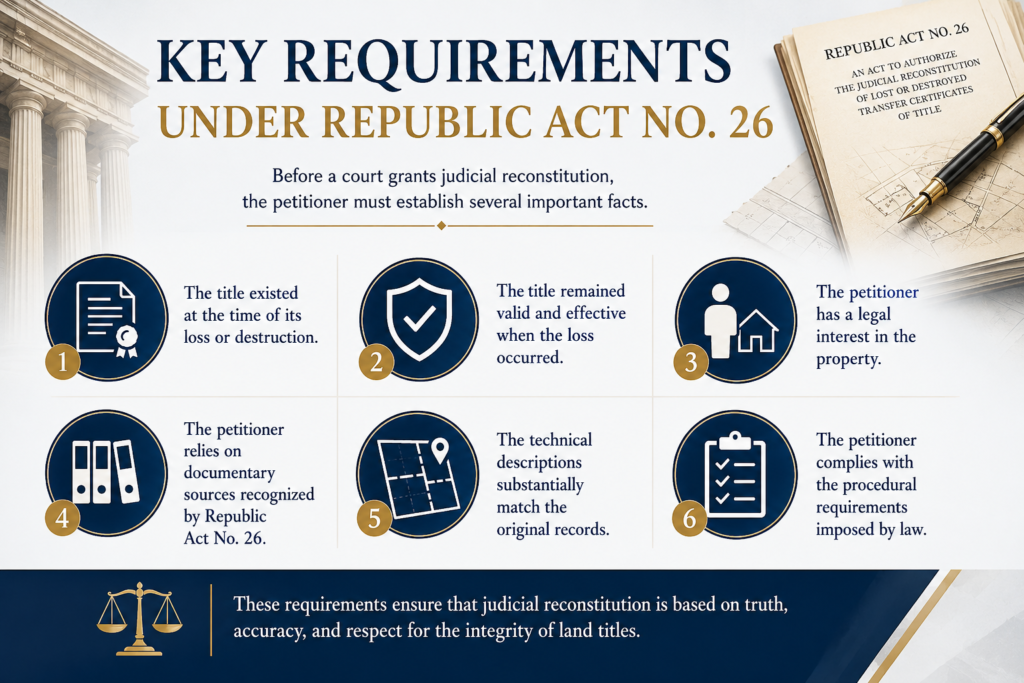
Key Requirements Under Republic Act No. 26
Before a court grants judicial reconstitution, the petitioner must establish several important facts.
Among the essential requirements are:
- The title existed at the time of its loss or destruction.
- The title remained valid and effective when the loss occurred.
- The petitioner has a legal interest in the property.
- The petitioner relies on documentary sources recognized by Republic Act No. 26.
- The technical descriptions substantially match the original records.
- The petitioner complies with the procedural requirements imposed by law.
These requirements help ensure that the restored title accurately reflects the original document.
Recognized Sources for Reconstitution
Republic Act No. 26 identifies specific sources that may support reconstitution proceedings.
Depending on the circumstances, the law recognizes documents such as:
- The owner’s duplicate certificate of title;
- The co-owner’s duplicate certificate;
- The mortgagee’s or lessee’s duplicate certificate;
- Certified copies previously issued by the Register of Deeds;
- Authenticated copies of registration decrees or patents;
- Registered instruments affecting the property; and
- Other documents that the law recognizes as sufficient under the circumstances.
These sources play an important role because they help verify the contents of the original title.
Consequently, property owners should preserve all available land records and supporting documents.
Common Misconceptions About Lost Land Titles
Myth #1: A Lost Title Means Ownership Is Lost
Many people believe that losing a title automatically means losing ownership.
That belief is incorrect.
A lost or destroyed title does not automatically extinguish ownership rights. However, the affected party must follow the legal process required for reconstitution.
The law provides a remedy, but the petitioner must satisfy the necessary requirements.
Myth #2: Any Document Can Replace a Lost Title
Another common misconception involves documentary evidence.
Some property owners believe that a tax declaration or a photocopy of a title automatically allows reconstitution.
Republic Act No. 26 does not support that assumption. Instead, the law identifies specific documentary sources that courts may consider during reconstitution proceedings.
Therefore, parties should carefully review the statutory requirements before filing a petition.
Practical Importance for Property Owners
Property owners benefit from understanding the rules on reconstitution.
First, knowledge of the process helps prevent unnecessary panic when records become lost or damaged.
Second, awareness encourages owners to preserve duplicate copies and other important property documents.
Third, understanding the requirements helps parties prepare the evidence needed for future proceedings.
Most importantly, familiarity with the law reduces confusion during a stressful situation involving property records.
Conclusion
The loss or destruction of a Torrens title does not automatically end ownership rights. Nevertheless, property owners must comply with the legal process established by Republic Act No. 26.
The Supreme Court’s ruling in Republic v. Spouses Bercede reinforces an important principle. Reconstitution restores an existing title. It does not create a new one. Furthermore, courts require strict compliance with the requirements imposed by law.
For that reason, property owners should understand the governing rules and preserve all available land records. Proper documentation can make a significant difference when pursuing reconstitution proceedings.
Related Articles
Readers who wish to learn more about Philippine legal issues may visit:
https://tamayaolawoffice.com/category/articles
Need Guidance?
Every property matter involves unique facts and circumstances. For concerns involving land titles and property documentation, it is best to consult a qualified legal professional for proper guidance.

Leave a Reply